
India is the land of arts and crafts. Many of these art forms which have been around for centuries are specific to regions and sometimes even families.
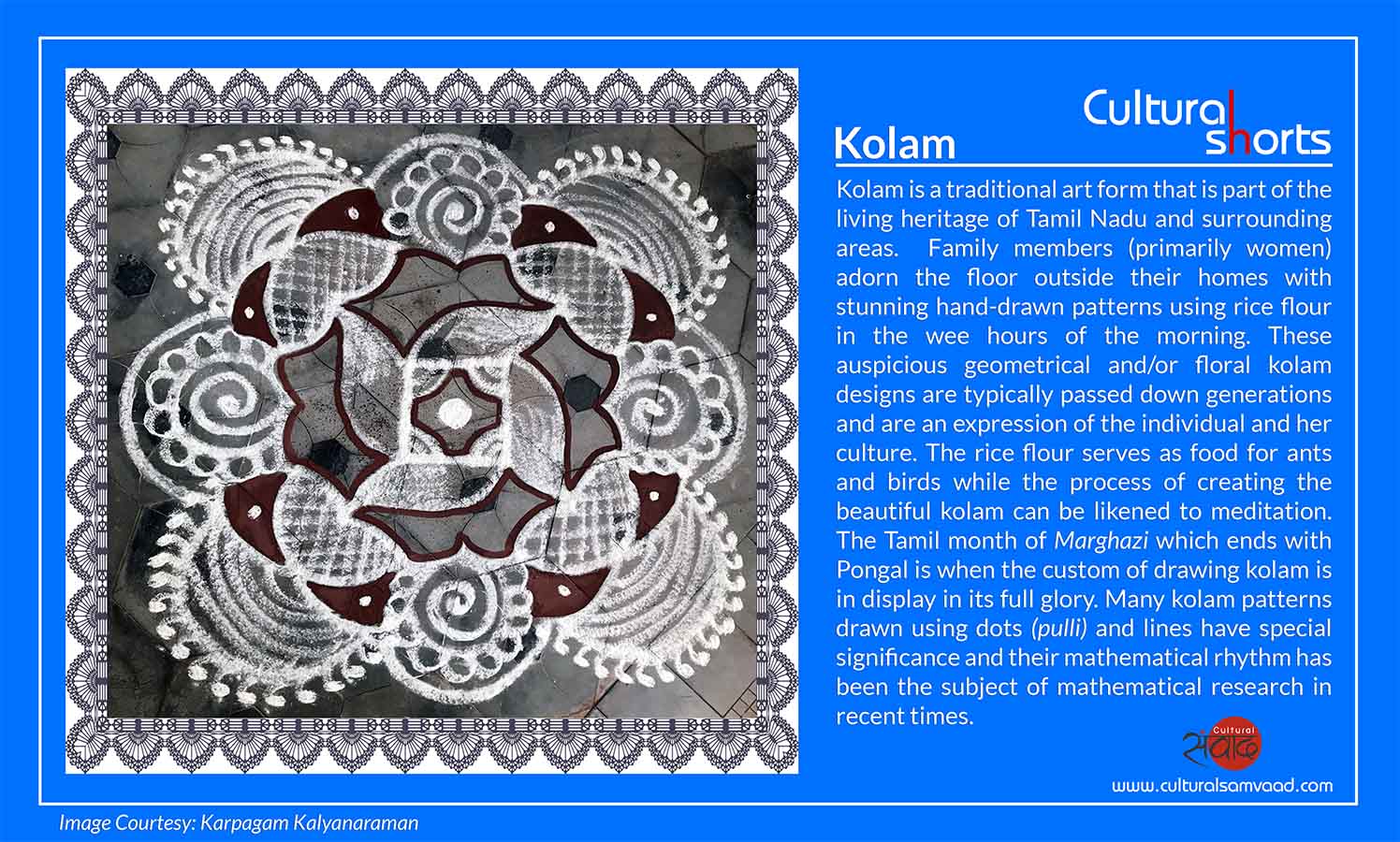
Kolam is one traditional art form that is part of the living heritage of Tamil Nadu and surrounding areas. Family members (primarily women) adorn the space outside their homes with stunning hand-drawn patterns using rice flour in the wee hours of the morning. These auspicious geometrical and/or floral kolam designs are typically passed down generations and are an expression of the individual and her culture. The rice flour serves as food for ants and birds while the process of creating the beautiful kolam can be likened to meditation or mindfulness. The Tamil month of Marghazi which ends with Pongal is when the custom of drawing kolam is in display in its full glory. Many kolam patterns drawn using dots (pulli) and lines have special significance and their mathematical rhythm has been the subject of mathematical research in recent times.
Read more about Pongal and other harvest festivals celebrated across India around this time.
कोलम के बारे में हिन्दी में पढ़ें|
Image Courtesy: Karpagam Kalyanaraman
Add comment