

Join Cultural Samvaad’s WhatsApp Community
The great Shri Rama is regarded as the seventh among the Dashavatars (7th avatar among 10 avatars or incarnations of Vishnu). He is worshipped by one and all and the story or katha is recounted at many festivals including Diwali, Dusshera and Ram Navmi.
The Ramayana composed by Maharishi Valmiki in Sanskrit over 2500 years ago is considered to be the earliest story of Rama available to us and is traditionally considered a part of our itihaas (thus it was) traditon. While many extant versions of this immortal work are said to be divided into seven kandas or books, most scholars believe that the seventh book – the Uttara Kanda is an interpolation. In this note and accompanying video, we tell you the popular katha of Rama and Sita across the first six kandas. Our rendition includes some later developments in the beautiful Ramakatha tradition that are not found in Valmiki’s Ramayana . The six kandas covered in this note include:
- Bala Kanda
- Ayodhya Kanda
- Aranya Kanda
- Kishkindha Kanda
- Sundara Kanda
- Yuddha Kanda
A Popular Version of the Story of Vishnu’s Rama Avatar |Ramayana
Bala Kanda
Long, long ago in the treta yuga, Ravana, the asura King of Lanka and his army had become very arrogant and powerful. The balance of the world was threatened. The time for Lord Vishnu to take avatar had come.
Ayodhya was an ancient city on the banks of the river Sarayu. It was ruled over by a Suryavanshi King called Dashrath. He and his three wives who did not have any children performed a great yagya (sacrifice). As a result, they were blessed with four sons. Queen Kaushalya gave birth to Rama who was none other than Shri Hari himself. Queen Kaikeyi gave birth to Bharat and Queen Sumitra gave birth to Lakshmana and Shatrughan.
The four handsome princes received rigorous education under the tutelage of the great Rishi Vashishtha and became Ayodhya’s pride. At the behest of Rishi Vishwamitra, Dashratha sent Rama and Lakshmana went to the deep forests to protect the rishis from the asuras and to Mithila where the swayamara of Janaka’s princess, Sita was being held.
Sita was married to Rama. Their divine union was accompanied by the marriage of the other princes to Sita’s sisters and was blessed even by the devatas. Rama and Sita, Bharat and Mandavi, Lakshmana and Urmila and Shatrughan and Shrutakirti returned to Ayodhya to begin the next phase of their life.
Ayodhya Kanda
When the time came for Rama to become crown prince of Ayodhya, Kaikeyi used a promise that Dashratha had given to her years ago to send Rama on exile for 14 years. In order to uphold his father’s words, Rama left Ayodhya. He was accompanied by his wife Sita and his brother Lakshmana who refused to leave him alone.
Unable to bear this sorrow, King Dashratha passed away. Months turned into years. Bharat who was devoted to his elder brother, ruled over Ayodhya as Rama’s representative while Rama, Sita and Lakshmana lived in the forests.
Retellings of the Ramkatha | Versions of Ramayana
Aranya Kanda
And then, in the forest where Rama, Sita and Lakhsmana lived, a series of events started unfolding. Ravana sent Maricha in the form of a golden deer to Rama’s hermitage to trick them. Sita was fascinated by the unusual deer and requested Rama to hunt it. When Rama and Lakshmana were away hunting the golden deer, the evil Ravana appeared as a sage, overpowered a helpless Sita and took her away to Lanka. On the way, when he heard Mata Sita’s wailing and loud cries for help, the king of birds, Jatayu tried to save Mata Sita unsuccessfully. However, before passing away, he managed to inform Rama about the gruesome incident and pointed them in the right direction.
Kishkindha Kanda
Rama was distraught and started looking for his beloved Sita. At Kishkhinda, he met his great bhakta Hanuman and forged an alliance with Sugriva. On Sugriva’s request, he killed the mighty Vanara ruler Bali who had unlawfully taken the throne from his brother. Rama, Lakshman, Hanuman, Vanara Raj Sugriva and his massive army including Angada set out in search of Sita towards the southern shores of Bharat.
Sundara Kanda
The mighty Hanuman flew over the oceans to Lanka to look for Sita. He met the sad but steadfast Mata Sita at Ashok Vatika and reassured her that her woes were about to end. An angry Hanuman ravaged Ravana’s golden Lanka by setting the city on fire.
Yuddha Kanda
Shri Rama and his formidable army crossed over to Lanka. A terrible war ensued between Rama and Ravana’s armies. Meghnada, Ravana’s mighty son who had defeated even Indra (he was also called Indrajit), gravely injured Lakshman. However, he was revived when Hanumana brought the Sanjeevani herb from the Himalayas. Shri Rama himself annihilated the valiant, gigantic Kumbharana, Ravana’s younger brother who was feared even by the devatas. The great warrior Lakshmana defeated and killed Meghnada.
Know More: Continuing Relevance of the Ramkatha
It was time for the final battle between the indomitable, maryada purushottama Rama and the fierce and arrogant Ravana. In the end, Shri Rama defeated Ravana, the one who was believed to be invincible and lay him to rest on the battlefield. Adharma had been vanquished, and the reign of Dharma had been reestablished by Rama who is the embodiment of Dharma itself. Sita and Rama were reunited. Rama coronated Vibhishana, Ravan’s brother, as the king of Lanka and fulfilled his duties.
The period of exile had also come to an end. Rama, Sita and Lakshmana returned to Ayodhya. The city sparkled with unbridled joy, and the family was reunited. Shri Rama who is regarded as the seventh avatar of Vishnu and Devi Sita who is Mata Lakshmi personified, ascended the throne of Ayodhya, heralding the golden period of Ramarajya.
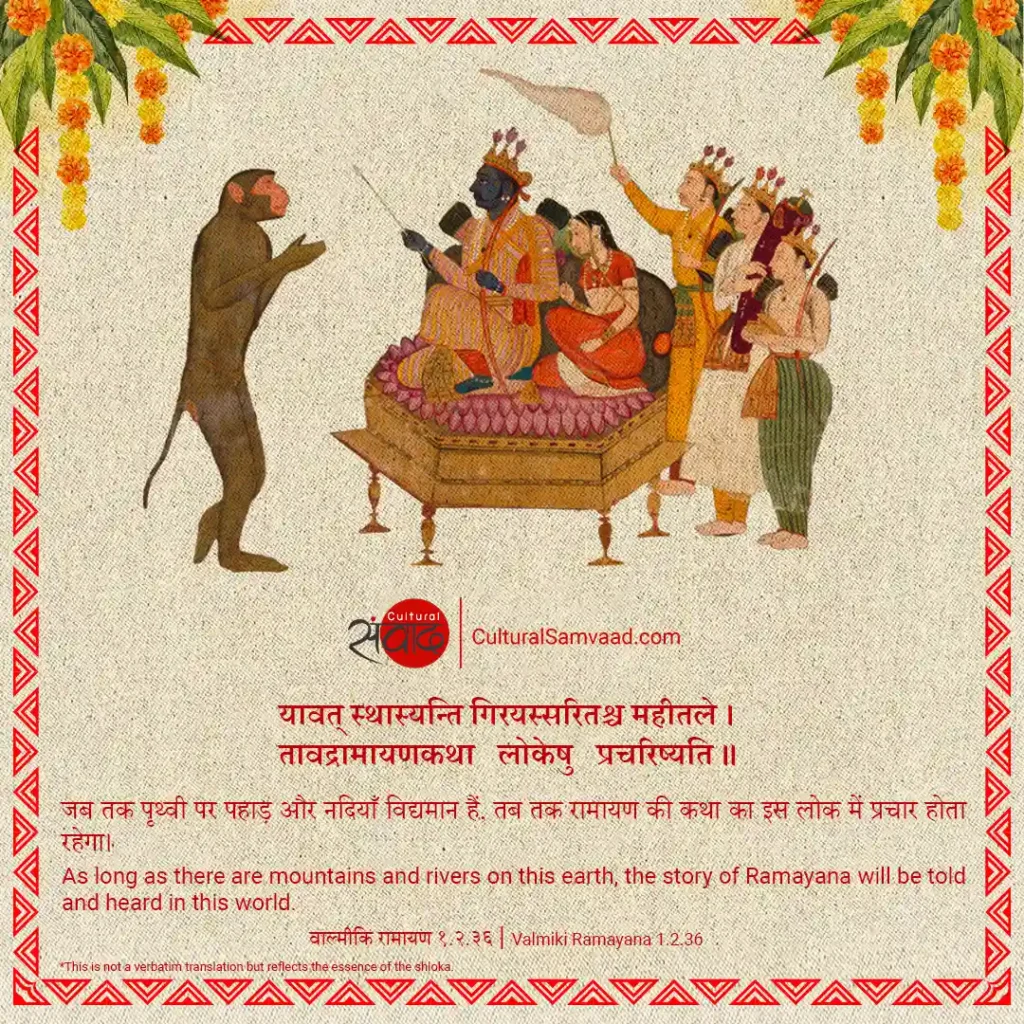
The story of Sita and Rama is said to be eternal and is retold across time and geography. Maharishi Vakmiki himself says:
यावत् स्थास्यन्ति गिरयस्सरितश्च महीतले । तावद्रामायणकथा लोकेषु प्रचरिष्यति ॥
As long as there are mountains and rivers on this earth, the story of Ramayana will be told and heard in this world.
वाल्मीकि रामायण १.२.३६ | Valmiki Ramayana 1.2.36
Take a Quiz on the Retellings of the Ramkatha

Add comment