
Join Cultural Samvaad’s WhatsApp Community
Shri Ganesha or Ganapati is accorded the status of ‘He who is worshipped first among all deities’. His unusual yet endearing form (head of an elephant and body of a human) has made him not only the favourite among devotees but also the delight of artists and sculptors. His iconography seems to be continuously developing and for the masses, some of his distinguishing features have become symbolic of deeper meanings.
We have created this short video and note together to exhort devotees, especially young children to go beyond Ganesha’s physical form and meditate on what lies beyond.
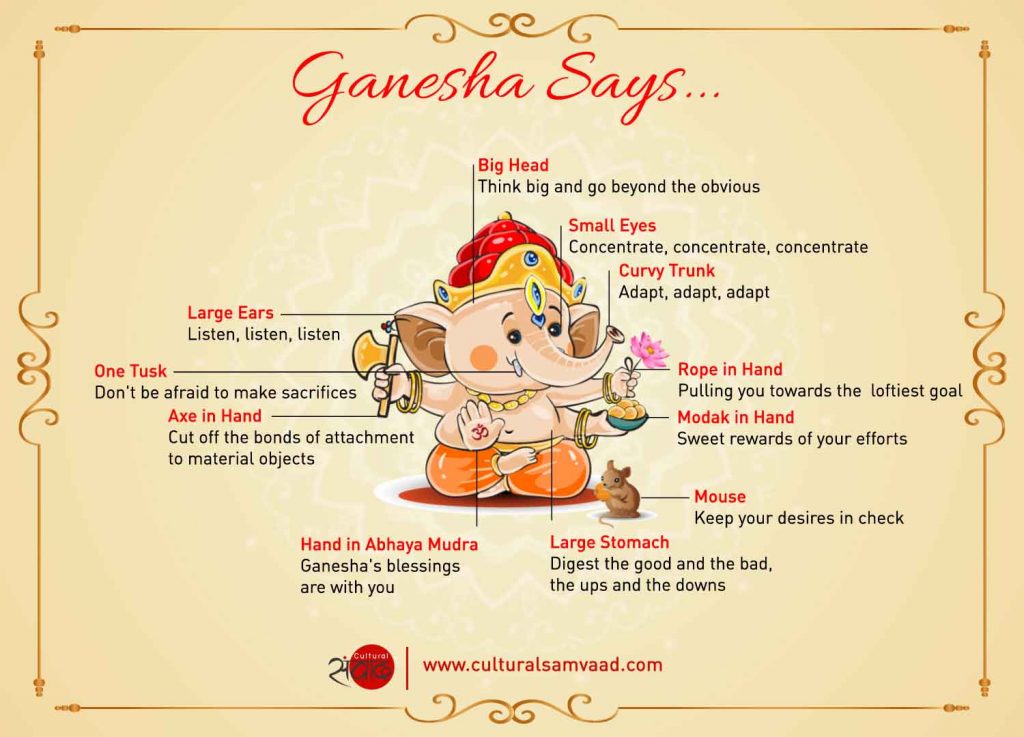
This is what Ganapati or Ganesha symbolises with his endearing form:
Big Head – Think big and go beyond the obvious
Small Eyes – Concentrate, concentrate, concentrate
Curvy Trunk – Adapt, adapt, adapt
Large Ears – Listen, listen, listen
One Tusk – Don’t be afraid to make sacrifices
Axe in Hand – Cut off the bonds of attachment to material objects
Rope in Hand – Pulling you towards the loftiest goal
Modak in Hand – Sweet rewards of your efforts
Hand in Abhaya Mudra – Ganesha’s blessings are with you
Mouse – Keep your desires in check
Large Stomach – Digest the good and the bad, the ups and the downs
It is also imperative to state here that some of the symbolism mentioned herein is not as per the textual tradition (which is true of Ganesha’s iconography, too) but more developed as part of folklore.

Very nicely depicted!
Thanks Romilaji!