


Join Cultural Samvaad’s WhatsApp community
Editor’s Note
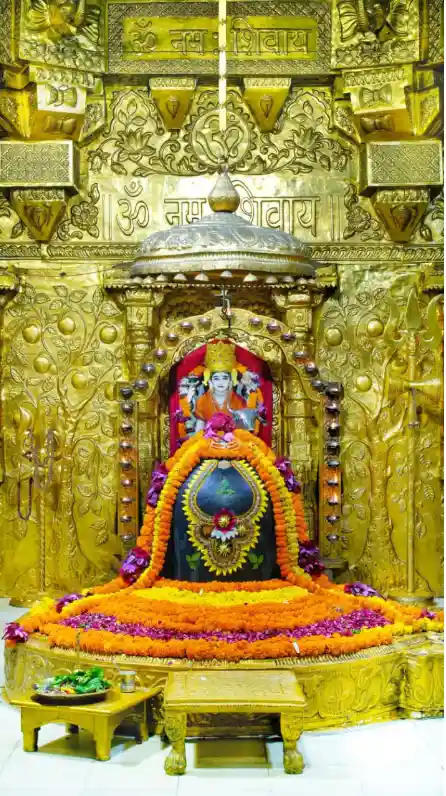
Somnath is generally regarded as the first among India’s twelve Jyotirlingas as it appears first in the famous Sanskrit stotra or hymn that lists them. By way of introduction, these jyotirlingas are believed to be self-manifest lingas or marks that are an embodiment of Rudra-Shiva and have a special place in the hearts of devotees.
Know More: The 12 Jyotirlingas of Shiva
Somnath (Lord of the Moon) is situated in the Prabhas area of modern-day Gujarat on the western coast of India. That the area has been sacred for over two millennia (if not more) is not disputed. Like many other holy sites in India, this temple has witnessed a chequered history and has been ravaged by both plunderers and time and has yet risen again and again as a symbol. The multiple documented raids of the infamous Mahmud Ghazni on this ‘symbol of the wealth, the faith and the culture of India’ and his repeated desecrations of this monument of faith are a gruesome chapter in Indian history.
The ensuing speech by Dr. Rajendra Prasad, the first President of India was delivered on May 11, 1951 on the occasion of the installation of the idol of Somnath in the Somnath Temple. It is worthwhile to note that he had accepted this invitation contrary to the advice of Pandit Jawaharlal Nehru who was the first Prime Minister of India.
इस भाषण को हिन्दी में पढ़ें
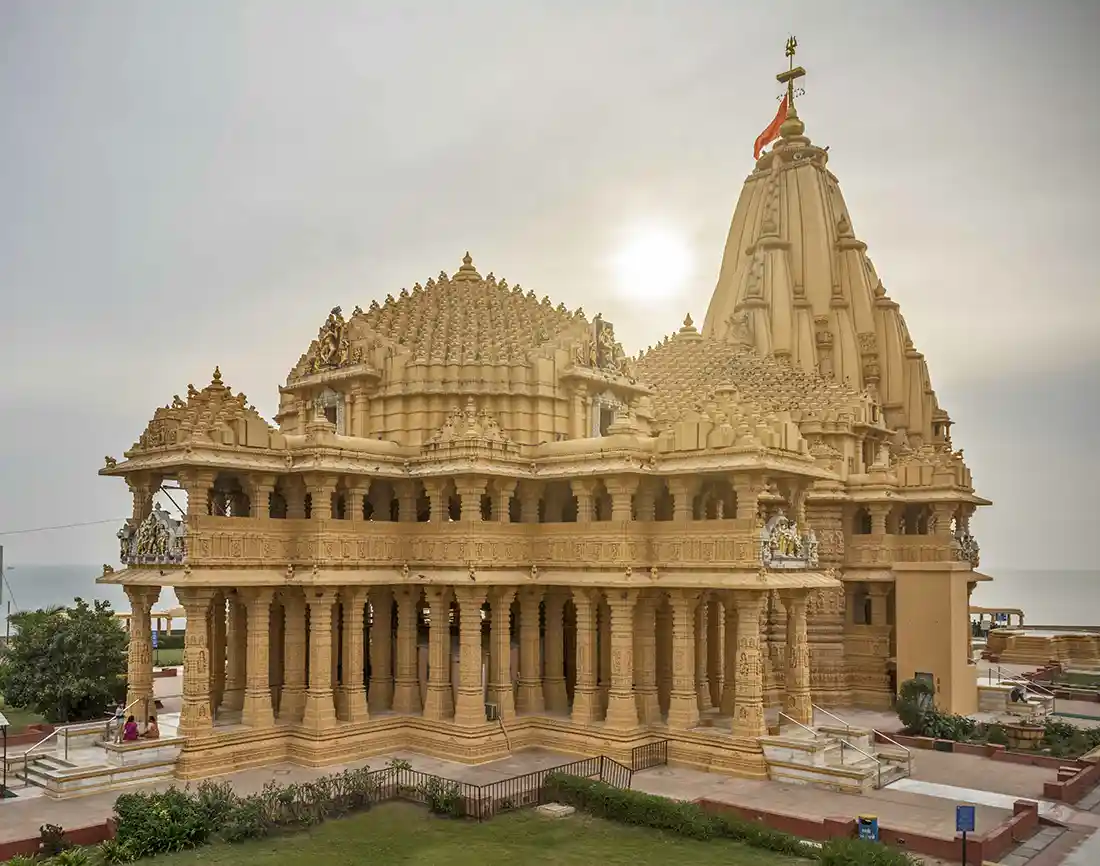
Dr. Prasad’s address acknowledged Sardar Vallabhbhai Patel’s monumental support for the reconstruction and not only elaborated upon the unparalleled importance of Somnath for India and Hindus but also stressed upon Bharat’s eternal message of pluralism and religious tolerance which echoes from the Vedas (एकं सद् विप्रा बहुधा वदन्ति) to contemporary times. For him, the rebuilding and reclaiming of Somnath’s glory was not an attempt to go back to the past but rather ‘a symbol of faith’ and a proclamation ‘that no man and no power in the world can destroy that for which people have boundless faith and love in their hearts.’ He reminded all Indians that Somnath was a temple of prosperity and it would only deemed to have been completed when the temple of prosperity of India had been erected.
This speech has been extracted from the ‘Speeches of President Rajendra Prasad’ published by The Publications Division, Ministry of Information and Broadcasting, Government of India. The emphasis has been added by the editor to draw the attention of the reader to important parts. Dr. Prasad’s and Pandit Nehru’s correspondence can be accessed at https://nehruarchive.in/documents/to-rajendra-prasad-13-march-1951-xek2wg (retrieved on 11th May, 2026).
Text of the Speech – ‘Somnath – A Symbol of Faith’ by Dr. Rajendra Prasad
According to our shastras, Somnath is one of the twelve Jyotirlingas. Naturally, therefore, this temple of Lord Somnath had become the symbol of the wealth, the faith and the culture of India. Its feet were washed by the ocean whilst its dome kissed the Heavens. In its vast quadrangle, innumerable devotees gathered from all the regions and provinces of India to place at die feet of Lord Shankara their boundless devotion and love and their great wealth. In those days, it was the centre of the faith and the wealth of this country. The fame of its unparalleled glory and wealth had spread to distant regions and countries. Unfortunately, during several centuries it had to suffer calamity after calamity. Again and again, it was desecrated and demolished. But, while the external symbols of a national faith may be destroyed, nothing ran destroy the fountains of that faith. It was for this reason that in spite of having numerous calamities there always remained in the hearts of the Indian people an undying faith and respect for this Temple of Lord Somnath. It ever was their determination to build this temple again every time it was destroyed, and they went on doing so time after time.
We hear the hum of a vast crowd of men and women gathered here from all parts of the country at this moment when this historic temple is coming to life again. In my opinion, we are having the good fortune of witnessing this sacred scene simply because of the creative urge and undying faith which dwell in the heart of man just as Brahma, the Creator, dwells on the Lotus of Lord Vishnu. This faith and creative energy are more powerful than all the weapons, all the armies and all the emperors of this world. By rising from its ashes again, this Temple of Somnath is, so to say, proclaiming to the world that no man and no power in the world can destroy that for which people have boundless faith and love in their hearts. We are re-installing the idol today and it is my conviction that it will live as long as it has place and foundation in the hearts of the people.
On this sacred and historic occasion, it is desirable lor all of us to realise the great secret of spiritual faith-that to have a glimpse of God or Truth, it is not necessary for all men to follow one and only one path. On the contrary, if man devotes himself with all love and faith to the service of his fellow human beings and if he dedicates himself to the establishment of the kingdom of love and beauty on this earth, he would surely be able to realise God whatever may be the manner of his worship. This great truth had been perceived by our ancient seers, and they had proclaimed it to mankind. They had consistently declared that though He is one, yet the wise describe Him in many ways and by many names. Similarly, according to the ‘Mahabharat’ all paths lead to God just as all rivers flow to the ocean. Unfortunately, this great truth of life and faith was not properly grasped by people in many ages which led to very destructive and terrible wars between different countries and people. It is plain, therefore, that religious intolerance cannot have any other consequence but to produce bitterness and immorality among men. This is the lesson of history, and I would like all my countrymen to grasp it firmly. In our country, particularly, it is very necessary that each one on us should realise that the best course is to act with a sense of respect and equallv towards every community and creed. In it lie, the welfare of our nation and country and of every one of us. This faith and conviction have impelled India to adopt the polity of secularism and to give an assurance that there shall be no discrimination on grounds of religion. Everyone would be provided equal opportunities. In conformity to this ideal. I have respect and affection for all the faiths. Even though I am a Sanatanist Hindu by faith and daily practice, yet I believe that every man can reach God by worshipping Him according to the dictates of his own faith. Not only have I respect for all religions and their places of worship, but I also go to them to pay my respect whenever possible. Whenever there is an opportunity. I go to the ‘ durgah – and the ‘masjid’, the church and the ‘gurudwara’ with the same feeling of respect with which I go to the temples of my faith. The present celebrations in my view proclaim this verv truth. It is very plain today that the policy of religious intolerance has always been and shall ever continue to be a failure.
I would also like you to realise that the restoration of this broken link of history does not and cannot imply that we are making or should make an effort to re-establish in our country the psychological, cultural, social and religious conditions which existed here in the centuries that are past. It is no doubt possible for man to turn back but it is not given to man to return to the moment that has passed away. In the world of time, man has no option but to continue marching forward. Indeed, he may look behind to get some light and guidance for the future, but he can never return. Today, our attempt is not to rectify history. Our only aim here is to proclaim anew our attachment to the faith, convictions and to the values on which our religion has rested since immemorial ages. We also proclaim to the world that the great truth of spiritual life teaches that every individual should have full independence and opportunities for rising to the highest glory of life to which his experience and natural talents entitle him. On this sacred occasion, it is the duty of each one of us to take a pledge that just as we have restored this historic temple—a symbol of our ancient faith—so also would we put new life into the Temple of Prosperity of our people.
In the past, our country was the industrial centre of the civilised world. Caravan loads of manufactured goods from this country used to go to distant lands. Gold and silver used to How into our coffers in exchange for our goods. Our exports were then very large, while imports were very small. Naturally, India of those days had become the home of gold and silver. In my view, the restoration of this Temple of Somnath would not be complete on the day when a fine building would have been constructed on these foundations. It would be complete only when the temple of our prosperity—of which the Temple of Somnath was but an external symbol—has been erected. In other words, the restoration of this temple would lie complete only when we raise the level of our culture to such a degree that if a modern Al Biruni sees our country, he would express himself about our culture in the same eloquent terms in which, a thousand years ago, Al Biruni had expressed himself about the India of his day.
This work of restoration had been started by Sardar Vallabhbhai Patel. He played a prominent part in weaving the scattered parts of India into a common whole. An idea had occurred to him that this symbol of the ancient faith of India should be restored to commemorate the restoration of Indian unity. By the grace of God, this dream of Sardar has been fulfilled to a certain extent. But it would have been realised fully only on the day when prosperity is restored to our people.
Note:
For more on the Somnath Temple and its historiography, the reader may want to refer to:
- Munshi, Kanaiyalal Maneklal. Somnath, the Shrine Eternal: Souvenir Published on the Occasion of the Installation Ceremony of the Linga in the New Somanatha Temple on May 11, 1951. 1951.
- Thapar, Romila. Somanatha: The Many Voices of a History. Penguin Books India, 2008.

Add comment