


Join Cultural Samvaad’s WhatsApp community
Bharat’s ageless Kumbh Mela (कुम्भ मेला) is undoubtedly the largest human gathering on earth. While an understanding of its history in a chronological matter is work in progress, there are innumerable pauranic tales which link it to times immemorial. One of the most famous stories that has been retold variously is that of one of India’s most enduring symbols – the Samudra Manthan or the churning of the ocean.
Know More: Kumbh Mela – India’s Intangible Heritage – History. Places, Rituals
What is the story of the Samudra Manthan?
Long, long ago, in a time that we cannot fathom, the devatas and asuras were engaged in many battles. The mighty asura king Bali defeated the devatas who went to Brahmaji for help. After much deliberation, it was decided that they would churn the ocean for amrit or the divine nectar that would make them immortal. Brahmaji advised the devatas to befriend the asuras to support them in this herculean task. The asuras agreed under the condition that they would also receive their share of amrit.
The majestic Mount Mandara became the churning rod while the King of Snakes – the great Vasuki became the churning rope. Vishnuji supported Mandara by taking the Kurma avatara (incarnation of a tortoise). The mammoth and unimaginable task of churning the ocean began.
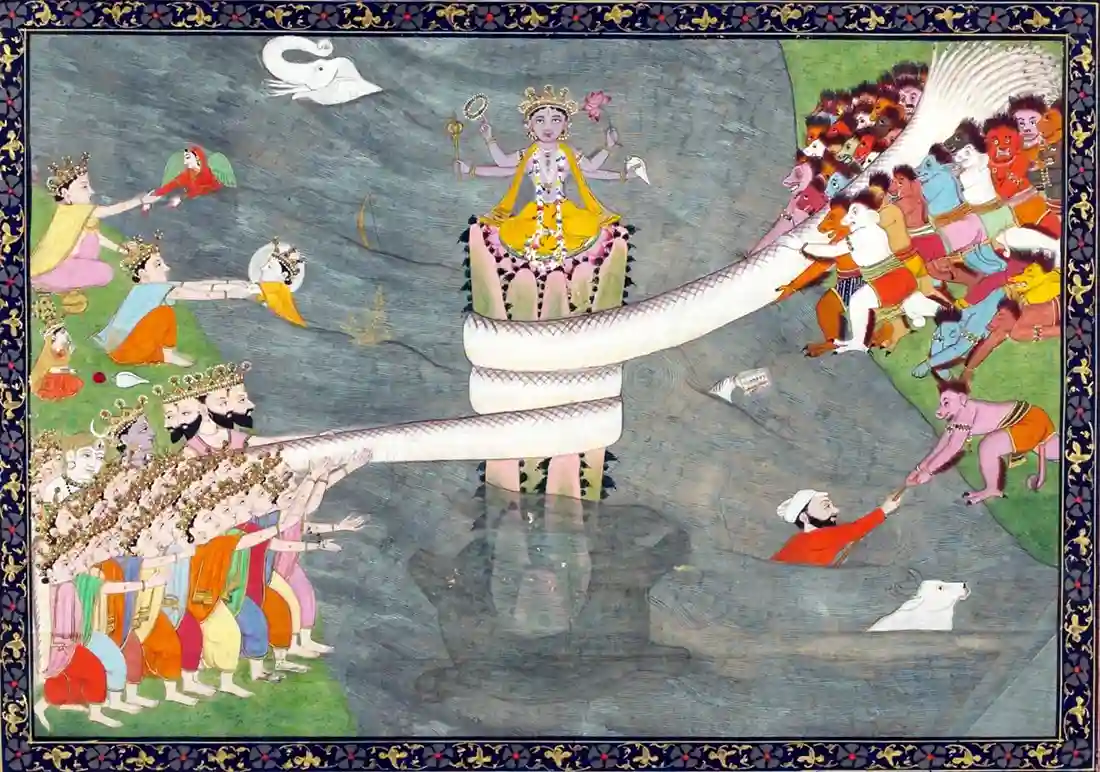
From the ocean emerged, halahala or a deadly poison that threatened to consume the universe. The god of gods, Mahadeva (Shiva) drank this poison and with the help of Parvatiji has held it in his throat since then. Thus, he became the compassionate Neelkanth.
The churning of the ocean threw up innumerable ratnas (gems) including the all-powerful, hiranyamayi (the one with a golden lustre) Lakshmiji, Surabhi – the divine cow, Airavata – the white elephant with four tusks, Ucchaishrava – the white horse and the celestial Kalpa Viriksha or Parijat tree. (Generally, the number of major ratnas that emerged from the churning of the ocean are said to be 14 in number).
It was time for the grand finale. Dhanvantari (also Dhanwantari), the divine physician emerged with the pot or kumbha (कुम्भ) of amrita. The churning stopped and both the devatas and asuras started arguing over the divine elixir. Vishnuji beckoned Garuda to fly away with the pot of amrit while the devatas and asuras fought for 12 days to gain control of this celestial kumbha. During these 12 days, it is said that drops of amrit fell over 4 places on earth – Haridwar (Uttarakhand), Prayaga (now Prayagaraj – Uttar Pradesh | earlier Allahabad), Ujjain (Madhya Pradesh) and Nasik (also Nashik – Maharashtra).
In order to end the dispute, Vishnu took the form of a beautiful woman called Mohini and distributed the amrita as he deemed fit. Of course, we know that the devatas got almost all of it but that is a story for another day.
कुम्भ मेले की कहानी – हिन्दी में
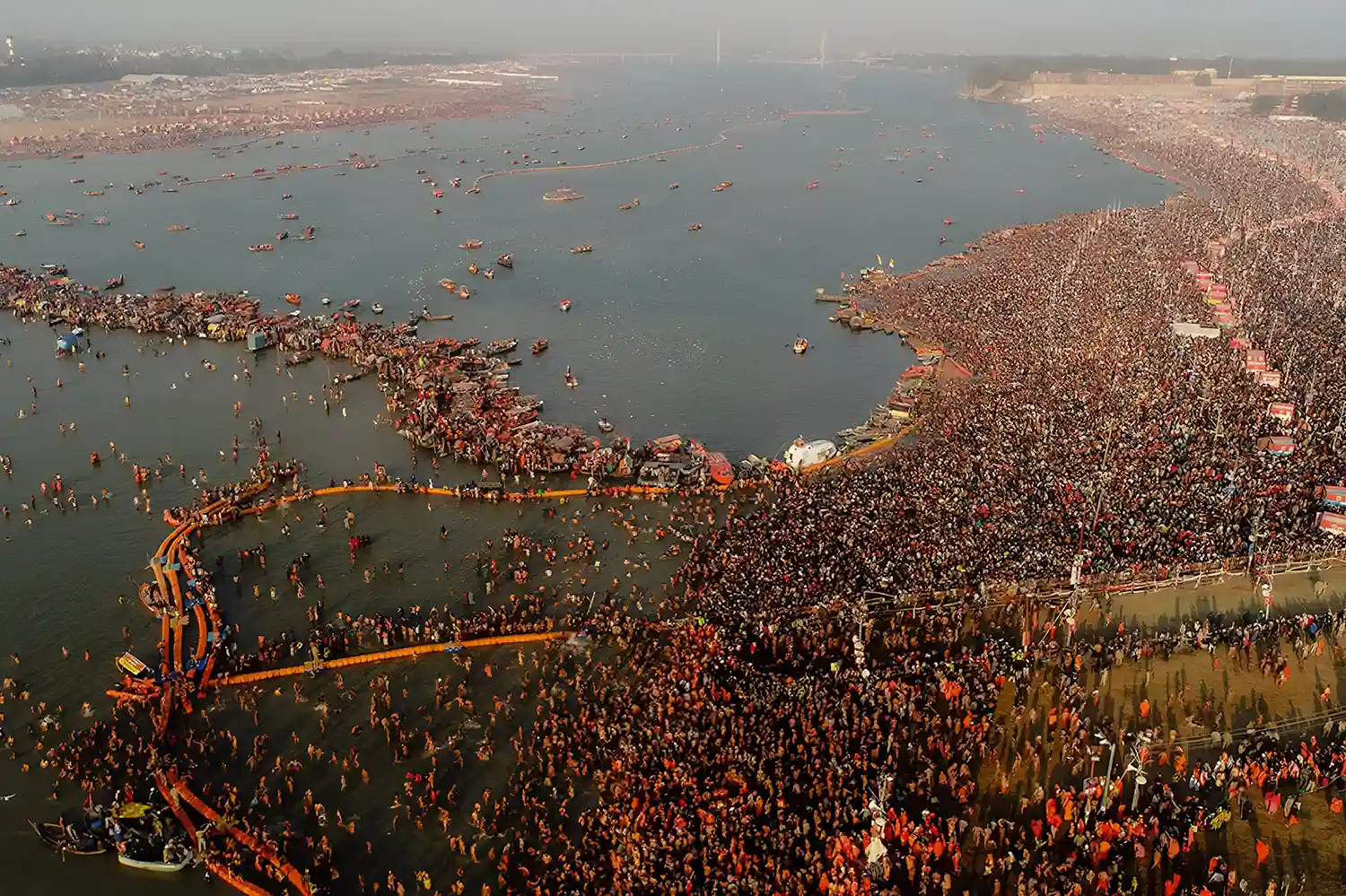
Even today, devotees from across the globe assemble during the Kumbh Melas at these divine teerthas (places of pilgrimage) – Haridwar, Prayaga, Ujjain and Nasik (Kumbh Melas are held every 3rd year at one of these 4 places by rotation) to take a dip in the holy waters which were once admixed with amrit. May these divine waters free us from all sins and lead us on the path of truth. May we conserve and preserve these divine waters for our future generations.
Notes:
- Amrita and amrit (अमृत) are used interchangeably in the article since both are commonly accepted.
- Kumbha and kumbh (कुम्भ) are used interchangeably in the article since both are commonly accepted. The word kumbh means a pot.
- The story of Samudra Manthan is found in many Indian texts including the Mahabharata and multiple Puranas and hence you may come across variations in the story. This immortal katha has also been depicted in visual art and sculptures across India and South east Asia including at Angkor Wat, Cambodia and Suvarnabhumi Airport, Bangkok, Thailand.
- The Republic Day parade of 2025 had a tableau of the Kumbh Mela (presented by the state of Uttar Pradesh) to mark the Prayagraj Mahakumbh of 2025 (a special Kumbh Mela held once in 144 years).


Samudra Manthan – Angkor Vat, Cambodia

Add comment