

Join Cultural Samvaad’s WhatsApp Community
Sharadiya or autumnal Navratri is a time for celebration across every nook and corner of India. Devoted to the Devi or Goddess, this sanatan Hindu festival is observed in multifarious ways. From the Garba of Gujarat to the Bathukamma of Telangana, from the Kolu or Golu of the southern states to the Ramlila of the northern states, the infinite colours of Navratri are a spiritual and aesthetic feast for devotees.
In West Bengal, Sharadiya Navratri is the time for Durga Puja (দুর্গাপূজা or দুর্গোৎসব) when Maa Durga in her manifestation as Mahishasura Mardini and her children are welcomed into every heart for a five-day grand celebration.
Read and Watch: Introduction to Durga Saptashati
The textual cornerstone of Durga Puja is the Durga Saptashati or Chandi and its timeless stories weave seamlessly into the rituals which also draw upon the Devi Bhagavatam and the agama texts of the Shakta tantra traditions.
The Earthly Setting for Durga Puja
The monsoon rain has retreated. The kash phool is dancing in the gentle winds of the sharad ritu (autumn season). The month of Ashwina (September or October) is upon us. It is the time for the grandest event of the year in Bengal and every other place on earth where destiny has taken probasi Bengalis (Bengalis who have migrated from Bengal). It is the time for the arrival of Maa Durga during Sharad Utsav.
The Countdown to Durga Puja: Making of the Pratima of Durga and the Pandals
Long before her much awaited arrival, as per traditional practice, in June or July on the day of the auspicious Rath Yatra, the mritshilpis and kumhars (clay artisans and potters) begin the sculpting of the divine pratima (image) of Durga with a pata puja (worship of the wooden frame on which the image is sculpted). For months, pratimashilpis (murtikaras) toil endlessly to give form to the formless Shakti.
And while the pratimashilpis strive to give form to Maa Durga, artists, craftspeople and designers come together to give form to exquisite pandals that not only house the Shakti and her children but also highlight the rich aesthetic and cultural legacy of Bengal.
Many months later, on the last day of the pitru paksha or Mahalaya Amavasya, as the sounds of জাগো তুমি জাগো (Jaago tumi jaago – Wake up, O Mother) reverberate on the earth in modern times*, the mesmerising eyes of the Pratima are painted in a ritual called chokkhodaan. Chokkhodaan is but a ritual enactment of the timeless katha of the formation of the 10-armed warrior Devi when the shaktis or energies of Brahma, Vishnu, Shiva and all the devatas coalesce together. The Devi Paksha is upon us.
The Two Faces of Maa in Bengal – Durga as the Warrior and as the Daughter
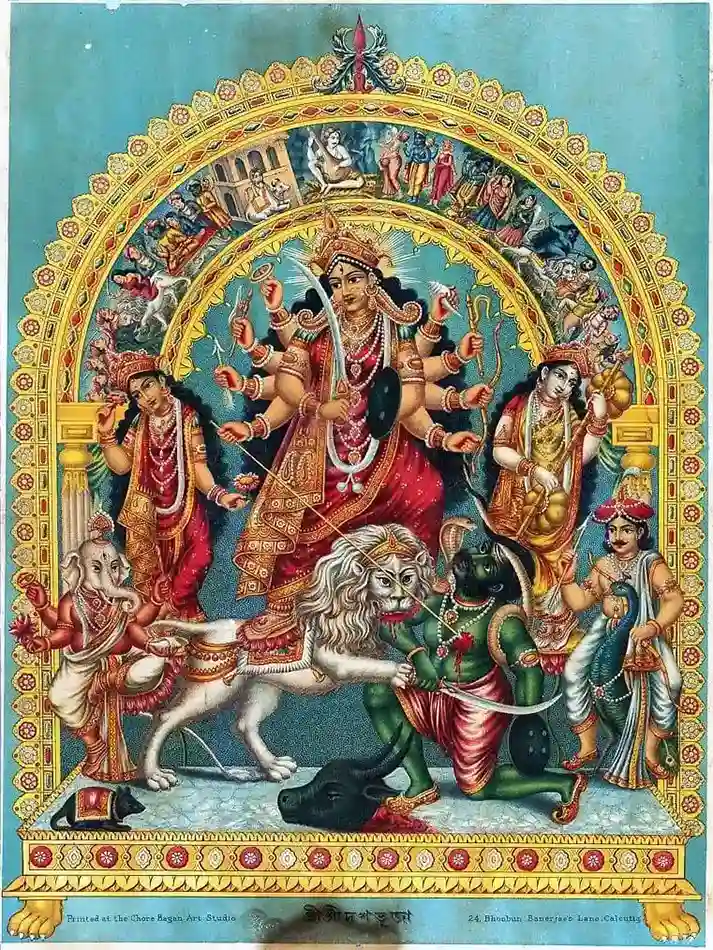
In the centuries-old Durga Puja of Bengal, the invincible warrior of Devi Mahatmya who sits on her lion and annihilates Mahishasura, seamlessly fuses with domestic traditions where she is Gauri, Uma and Parvati, the daughter of the Himavan and Menaka, the consort of Mahadeva and the mother of two daughters Lakshmi and Saraswati and two sons Karthikeya and Ganesha. The five-day festival is her annual vacation where she descends from Mount Kailash with her children and rushes to the loving arms of her parents and devotees on earth. She is the eternal mother, but she is also the much-loved daughter who is the cynosure of all eyes for five days – from Shashthi to Dashami of Sharadiya Navratri.
Sanskrit Greetings for Durga Puja
Bengali songs in the Shakta tradition capture the synthesis of Durga as the mother and daughter and the waves of emotions that sweep away the hearts and minds of her devotees. It is worth quoting her mother Menaka’s lament in the words of Ramaprasad Sen – গিরি, এবার আমার উমা এলে, আর উমায় পাঠাব না (Giri, ebar amar Uma ele, ar Umay pathabo na). ‘Oh Giri (Himavan), this time when my Uma comes, I shall not send her back.’
Panchami, Shashthi and Saptami: Awakening, Arrival of the Devi and Prana Pratishtha
On the Panchami or Shashthi**, at dusk, Maa Durga is traditionally awakened with the bodhan ritual by installing a copper vessel filled with water at the base of a bilva tree.
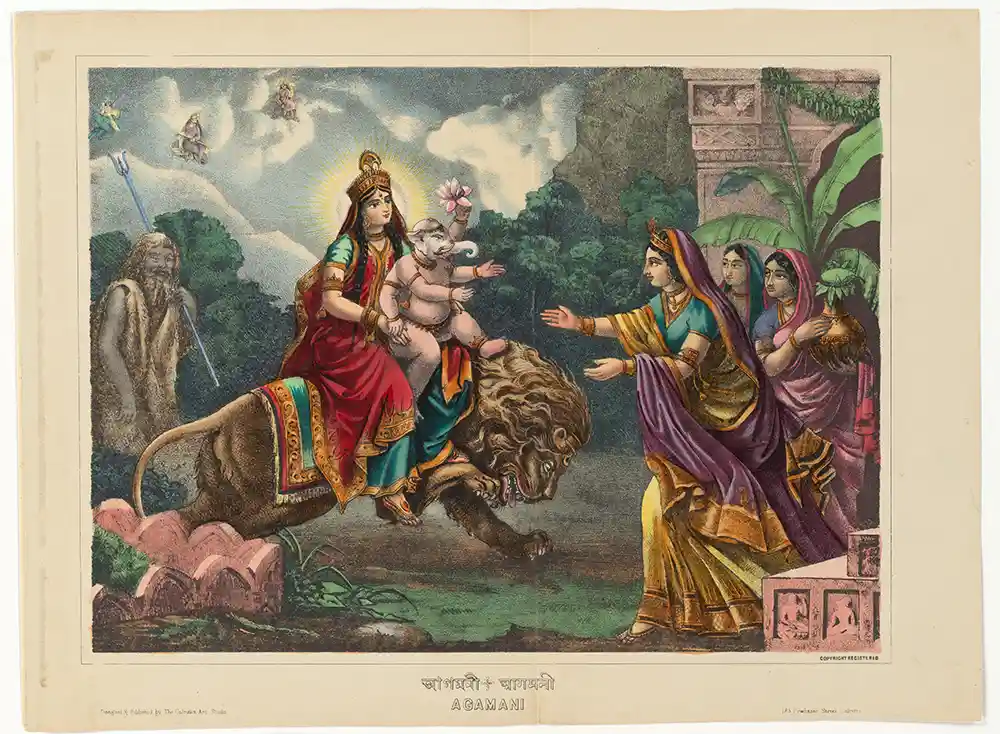
On Shashthi, the day of her aagmoni (arrival), the pratima of Maa Durga is brought home or installed in intricately embellished sarbajanik (community) pandals. Rituals include kalparambha i.e. taking a vow to conduct the puja and installation of the ghata or a copper pot filled with water; adhivasa i.e. the symbolic invocation of the Devi in a Bilva tree and amantrana i.e. extending an invitation to her to accept the offerings that would be made to her on the following day.
The bodhan ritual of Durga during the Sharadiya Navratri is also referred to as akal bodhan (awakening at a non-scheduled time). Both this rite and Durga Puja are linked to a fascinating narrative from the Ramakatha tradition. Krittibas’s famous 15th-century Bengali epic – শ্রীরাম পাঁচালী (Sriram Panchali – popularly referred to as Krittibas’ Ramayana), recounts that despite Rama’s best efforts at defeating Ravana, he was unsuccessful. Ravana had received the grace of Devi Bhagavati who was protecting him and he was unassailable. In order to propitiate Durga, on the advice of Brahma, Rama invoked the goddess, completed a ritual reading of the Chandi, and worshipped Durga with 108 blue lotuses. Pleased with his offerings, Mahadevi blessed Rama who eventually vanquished Ravana. Since the Goddess was traditionally worshipped during Chaitra and Ashwina is when she was believed to be resting, her untimely invocation and awakening became akal bodhan. Rama’s akal bodhan of Maa Durga and his Durga Puja in the middle of the battlefield continue to this day or so says the legend.
Read: The Ramakatha Tradition in India
On Saptami, Maa Durga is invoked in a group of nine plants or the Nabapatrika (popularly referred to as kola bou) for she who herself is prakriti and fertility incarnate can only be invoked in that which is alive. A traditional prana pratishtha ceremony of the exquisite pratima is performed among the blowing of conch shells and the ringing of bells. Maha snana i.e. ritual bathing, an elaborate puja referred to as the shodasha upachara puja, and maha arati follow.
Maha Asthami and Maha Navami: Anjali, Kumari Puja, Sandhi Puja and Homa
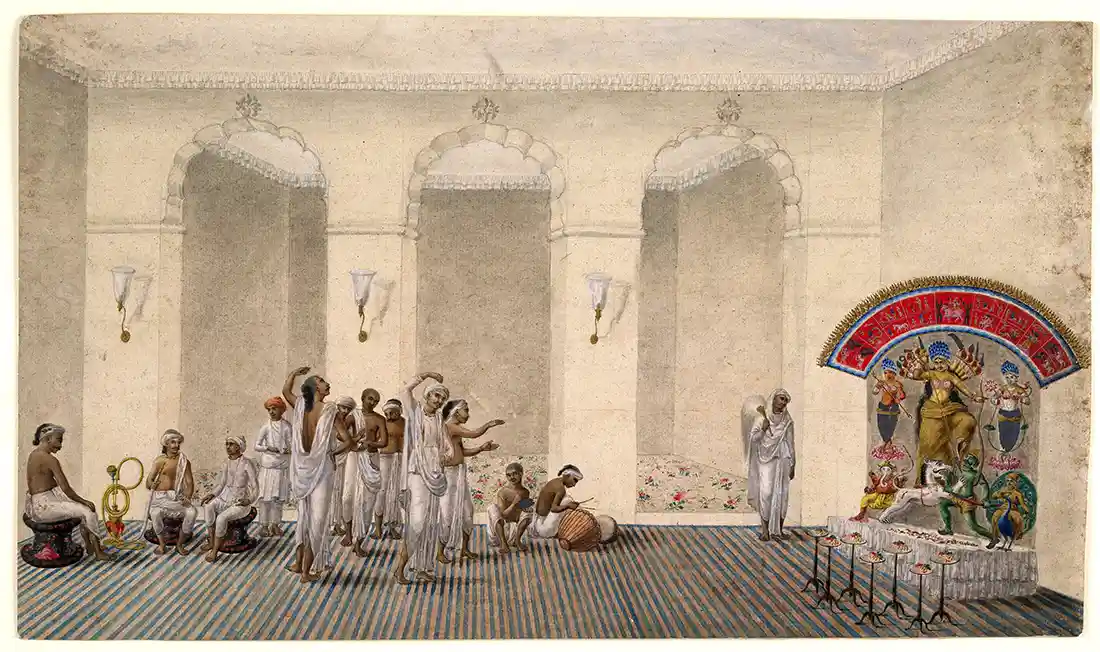
Devotional offerings of multi-coloured flowers or anjali to the great goddess and her offspring and kumari pujan i.e. the worship of young girls as manifestation of the Devi herself are the highlights of the Maha Ashtami puja. The festivities reach their crescendo during Sandhi Puja – the last 24 minutes of Ashtami and the first 24 minutes of Navami. This auspicious 48-minute period is when Maa Kali is said to have annihilated the ferocious demons Chanda and Munda to become Chamunda. Diyas that radiate Maa Durga’s infinite light and energy are lit by devotees, and symbolic sacrifices (bali daan) of white pumpkin, sugarcane, etc. are offered to the Devi.
The ninth day or Maha Navami witnesses the performance of homas that are a syncretic form of the age-old Vedic yajna and traditional tantric rituals.
It must be mentioned that Shodasha upachara puja and maha arati are also performed on Ashtami and Navami in addition to the specific rituals highlighted above.
Beyond the rituals, Durga Puja is a feast for the senses. The bhog or food offered to Maa which is partaken as the much-awaited prasad by devotees, the scintillating sounds of the dhak (traditional drum) and the enthralling signature dhunuchi naach (traditional dance with the performer carrying a dhunuchi, a clay incense burner holding burning coconut husk and dhuno, a kind of gum) are the quintessential elements of this aesthetic celebration of Maa.
Bijoya Dashami: Victory and Farewell
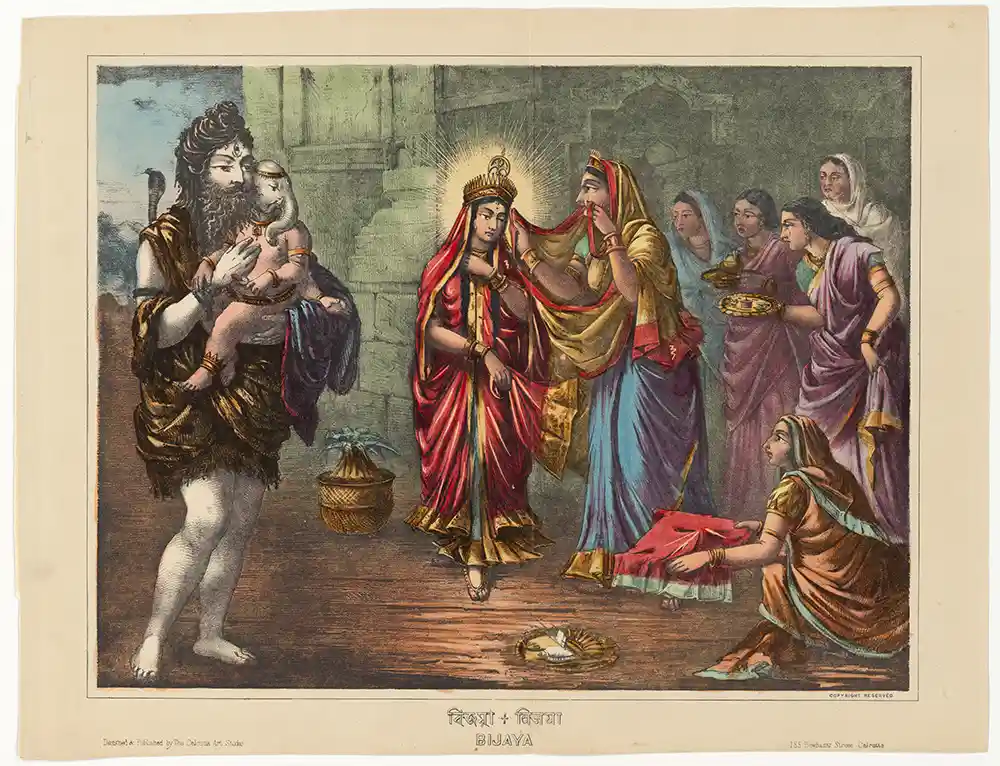
Bijoya Dashami (Vijaya Dashami) is the day when the undefeated, aparajita Maa Durga slew the demon Mahishasura and achieved decisive victory. It is also the day of Bidaai, when the beloved daughter has to go back home. There is much joy and there is much sorrow.
Read and Watch: The Story of Mahishasuramardini
The rituals include a traditional visarjan where the ghata is dismantled and a darpan or mirror is symbolically dipped in holy water which reflects the face of the divine pratima. It is then time for varana and sindura khela, ceremonies that are exclusively reserved for women. During varana, women feed sweets, betel leaf and supari to Maa Durga and her lion, her children and their vahanas, and even Mahishasura. When they smear the Goddess and each other with vermilion, they not only invoke Maa’s divine blessings but also bless their daughter as she returns to her abode.
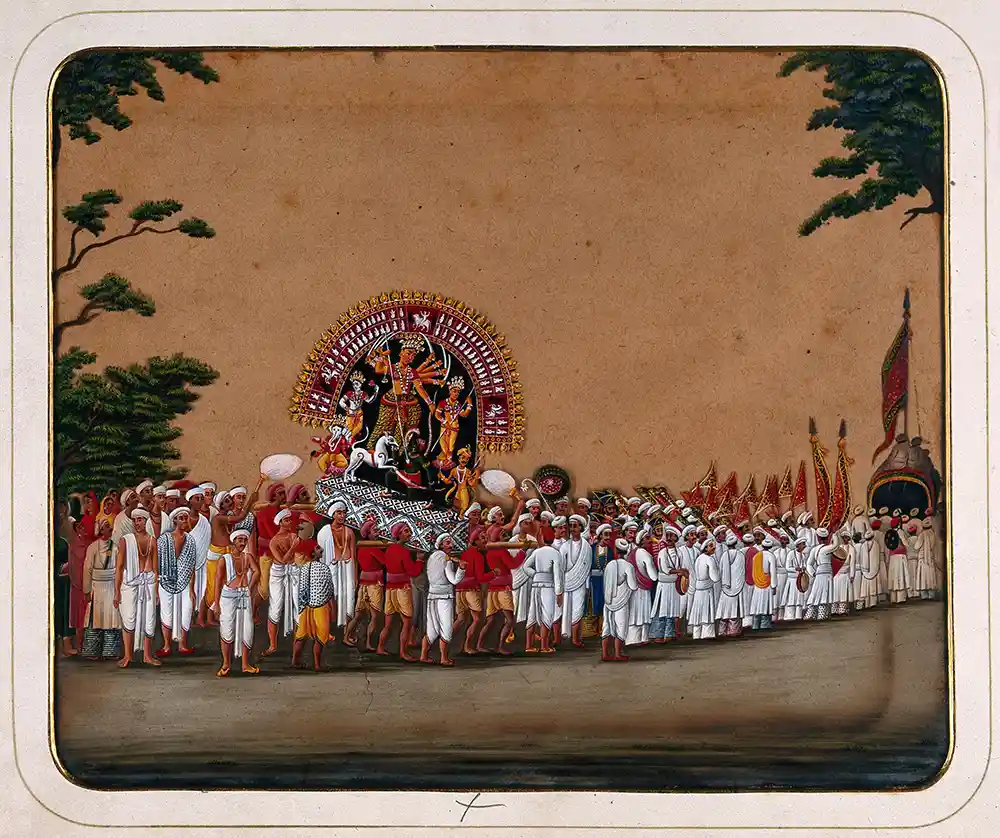
The pratima is carried in processions with much fanfare and immersed in the Ganga or other holy rivers and water bodies. As the auspicious shanti jal (sacred water from the spot where the pratima is immersed) is sprinkled on devotees for peace and prosperity, one realises that one may have bid farewell to a temporal form of Durga but the formless, timeless Bhagwati stays in our homes and hearts forever, in the waters that sustain us, in the living beings that inhabit the earth and in every element of our wondrous prakriti or nature.
May the all-pervading Bhagwati be ever auspicious for us.
देवि प्रपन्नार्तिहरे प्रसीद प्रसीद मातर्जगतोऽखिलस्य।
प्रसीद विश्वेश्वरि पाहि विश्वं त्वमीश्वरी देवि चराचरस्य॥
O Devi, you remove the sufferings of those who approach you and seek refuge in you. Please be gracious to us. O Mother of the Universe, please be benevolent. O Presiding Deity of this World, please protect one and all. O Devi, you are the ruler of all that is moving and not moving in this cosmos.
Durga Saptashati 11.3
‘Durga Puja in Kolkata’ was inscribed in the UNESCO Representative List of the Intangible Cultural Heritage of Humanity in 2021.
Notes:
- *The playing of Birendra Krishna Bhadra’s enchanting 90-minute rendition of Mahishasura Mardini at dawn on Mahalaya since it was first aired by All India Radio in the early 1930s has now become integral to the tradition of Durga Puja. For me, জাগো দুর্গা জাগো দশপ্রহরণধারিণী (Jago Durga Jago Doshoprohoronodharini) is one of the high points that never fails to uplift and signal the onset of Durga Puja.
- Chokkhodaan or chakshudaan is an important ritual in the sanatan tradition where image worship is centred around darshan (to see). Since the Divine which is embodied in the image beholds us as we behold the Divine, the eyes or chakshu are perhaps the most important feature of the image.
- **Bodhan or awakening of the Goddess is performed depending on the timing of the tithis as per the Hindu panchanga. Since it is performed at dusk, it is performed on Shashthi if the tithi is Shashthi during early evening or on Panchami if the tithi will change during early evening.
- Shodasha Upachara Puja is a traditional Hindu puja that has sixteen steps and is offered to all deities with some minor variations. It involves invocation and prarthana, ritual bathing and offering of vastra (clothes), flowers, naivedya (food), fruits, betel leaf and nut, lamp, and arati among others.
- The rituals have been explained in a simple and accessible manner and are not exhaustive in nature. Their timing, methodology and sequence may differ depending on the tradition that the puja follows.
- Glossary for the Tithis – Panchami is Tithi 5 of the fortnight, Shashthi is Tithi 6, Saptami is Tithi 7, Ashtami is Tithi 8, Navami is Tithi 9 and Dashmai is Tithi 10.
- We are immensely grateful to Belur Math – https://belurmath.org/ whose extensive documentation of the Durga Puja rituals have played a critical role in the making of the video and the essay.

Add comment