

Join Cultural Samvaad’s WhatsApp community
What is Durga Saptashati or Devi Mahatmya?
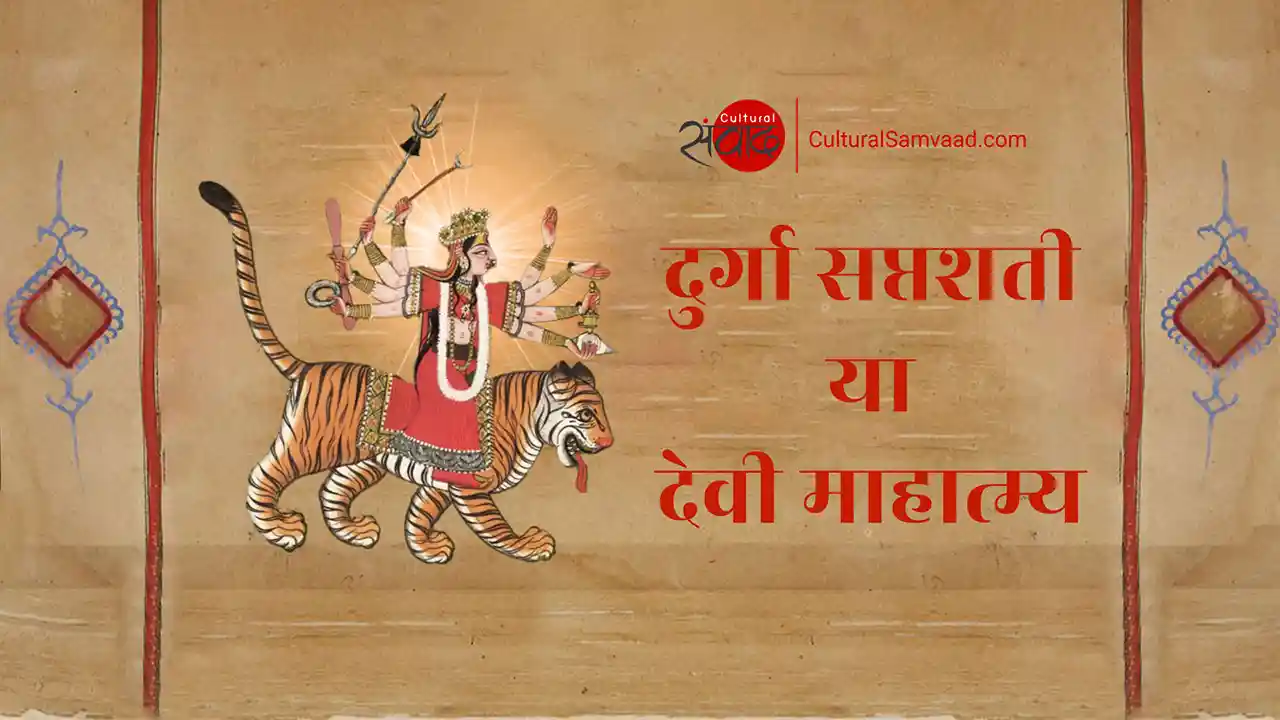
Durga Saptashati (दुर्गा सप्तशती) or the Devi Mahatmya (देवी माहात्म्य) is a centuries-old text recited by many Hindus especially during the observance of the great festival of Navratri. The Durga Saptashati is also popularly referred to as the Chandi Patha (चण्डी पाठ) or simply as the Chandi. It is among the loftiest of puranic compositions and occurs as a part of the Markandeya Purana, one of the oldest 18 Maha Puranas in the Hindu tradition. Durga Saptashati is probably the oldest extant text in the world devoted entirely to a fiercely independent Goddess who is also The Supreme Being – The Ultimate Godhead – The Divine Feminine.
The Goddess Durga as we know her today in India and large parts of the world has been shaped to a large extent by this text which has withstood the test of centuries [i]. At the time of its composition, it was probably an attempt to synthesise and crystallise millennia old traditions of goddess worship in India [ii] and drew upon many well-known stories and kathas in wide circulation at that time. Sapta means seven and shata means hundred and hence, the title implies a text with 700 verses. The verses are divided into 3 main narratives over 13 chapters which correspond to Adhyayas 81 – 93 of the Markandeya Purana.
The biggest achievements of the Chandi are probably its contribution to the arts and iconography of the Goddess and its elucidation of the basic tenets of spiritual thought in a narrative form. The simple yet engaging narratives make abstruse philosophical ideas accessible and comprehensible to the common devotee. In addition, Durga Saptashati also serves as a basic text for re-evaluating and recasting gender equations in contemporary Indian and global social orders given that the composer(s) seem to have anticipated modern women empowerment issues millennia ago or maybe the times have changed but the debate hasn’t… A detailed note on the contemporary relevance of the Devi Mahatmya is available separately.
Read and reflect on the contemporary relevance of the Durga Saptashati
Structure of the Durga Saptashati
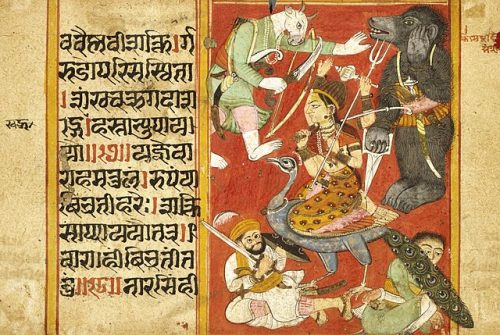
As mentioned earlier, the 700 verses of the Durga Saptashati can be roughly divided into three main episodes (referred to as charitras ) over its thirteen chapters and a frame narrative to weave the three episodes together [iii]. The frame narrative speaks of a king named Suratha and a merchant named Samadhi who meet while seeking refuge in the hermitage of Rishi (sage) Medha. A string of misfortunes had struck both of them and they had been deceived by their kin. Befuddled by their own circumstances and attachments to their lost possessions and their loved ones who had deceived them, they approached Rishi Medha for advice. The Rishi explained to them, that they, like the Universe, were controlled by the great Devi Bhagwati Mahamaya [iv] who ensures that all beings are caught in endless cycles of birth, death and rebirth to maintain the natural cosmic order. He then proceeded to extol her major exploits in the text’s three episodes.
दुर्गा सप्तशती की कथा एवं परिचय हिन्दी में पढ़ें
Episode 1: Devi Mahamaya, Vishnu and the end of Madhu and Kaitabha
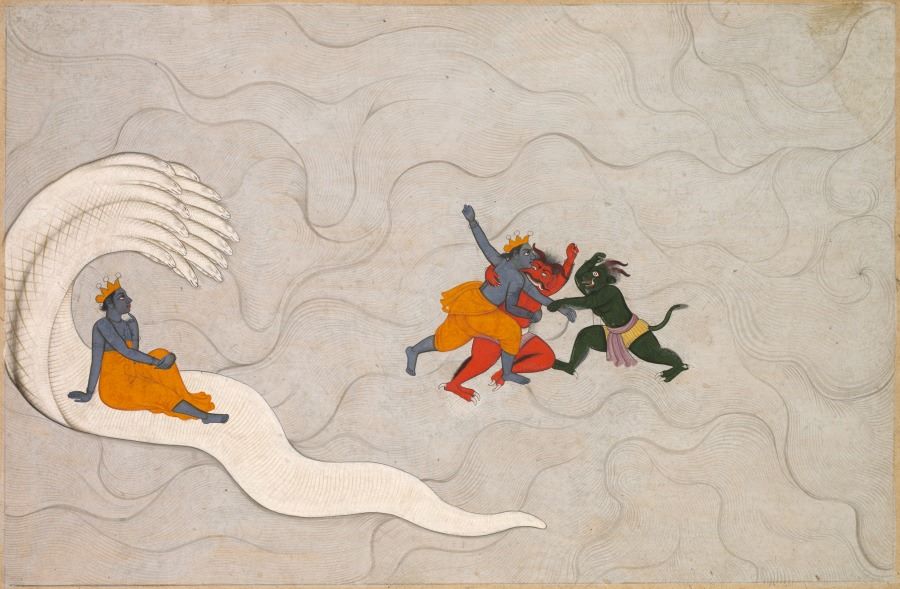
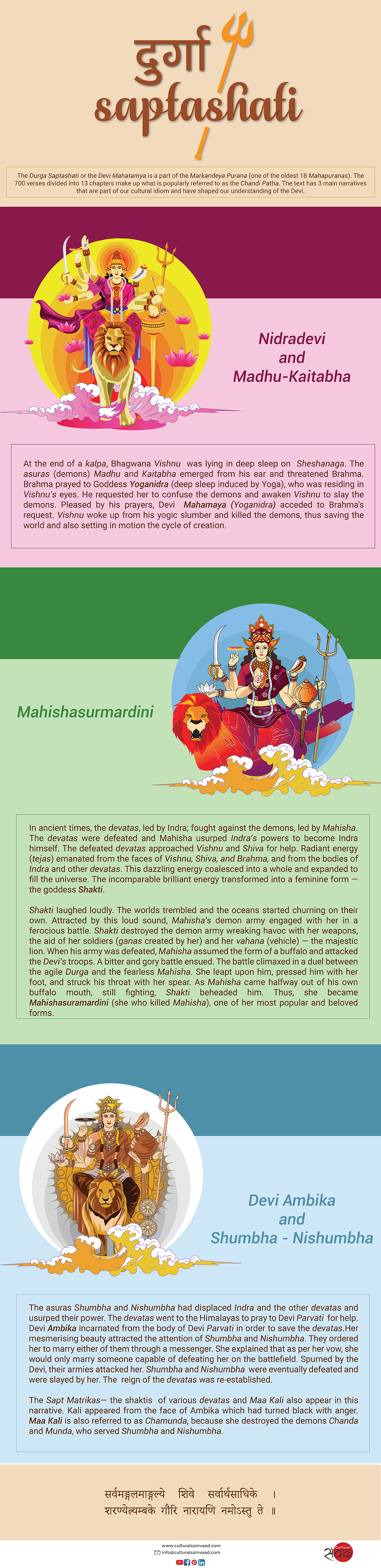
The First Episode or the pratham chaitra that is narrated in Chapter 1 is a retelling of the famous katha of the demons (asuras) Madhu and Kaitabha who threatened Brahmaji at the end of a kalpa when the whole universe was covered with water and Vishnuji was resting in yogic slumber. Brahma prayed to the Goddess Yoganidra (deep sleep induced by Yoga), who was residing in Vishnu’s eyes, beseeching her to confuse the demons and awaken Vishnu to slay the demons. Propitiated by his prayers, Devi Mahamaya (Goddess Yoganidra) did as requested. Vishnu woke up from his yogic slumber and killed the demons, thus saving the world and setting the cycle of creation in motion.
Read and watch the detailed story of the First Charitra and understand its significance
सर्वमङ्गलमाङ्गल्ये शिवे सर्वार्थसाधिके ।
शरण्ये त्र्यम्बके गौरि नारायणि नमोऽस्तु ते ॥
Oh Narayani, salutation be to you. You are the auspicious in all auspiciousness and the one who blesses her devotees with all that is good. You are the one who accomplishes all goals, you are affectionate to those who seek refuge and you are the three eyed Gauri.
Episode 2: Mahishasuramardini
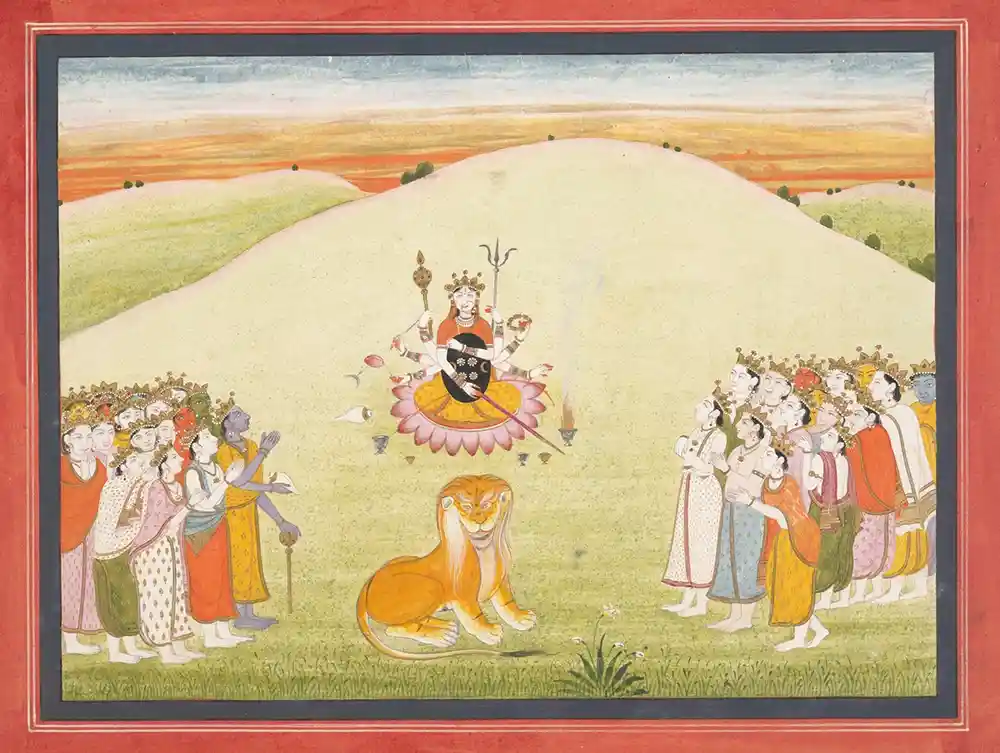
The second episode or madhyama charitra narrated in Chapters 2-4 of the text is devoted to the Devi’s most celebrated form – ‘Mahishasura mardini’. In ancient times, the devatas (gods in common parlance), led by Indra; fought against the demons, led by Mahisha (buffalo in Sanskrit – vehicle of Yama – commonly god of death). The gods were defeated by Mahisha and he usurped Indra’s powers to become Indra himself. Mahisha ruled over all realms of the Universe. The defeated gods then approached Vishnu and Shiva for help. Vishnu and Shiva were enraged. Radiant energy (tejas) emanated from the faces of Vishnu, Shiva, and Brahma, and from the bodies of Indra and other gods. This dazzling energy coalesced into a whole and expanded to fill the Universe. Lo and behold, this incomparable brilliant mountain of energy transformed into a feminine form – the great goddess Shakti.

Image Courtesy: National Museum, Delhi
Shakti laughed so loudly that the worlds trembled, and the oceans started churning on their own. Attracted by this loud sound, Mahisha’s demon army engaged with her in a battle which is described in vivid detail in the text. She destroyed the demon army wreaking havoc with her weapons, the aid of her troops (ganas created by her) and her vahana (vehicle) – the majestic lion. Upon witnessing the defeat of his generals and army, Mahisha assumed the form of a buffalo and attacked the Devi’s troops. A bitter and gory battle ensued. The battle climaxed in a duel between the agile Warrior Goddess and the fearless Mahisha. She leapt upon him, pressed him with her foot, and struck his throat with her spear. As the demon came halfway out of his own buffalo mouth, still fighting, Shakti beheaded him, thus earning the laudatory title of Mahishasuramardini (she who killed Mahisha). The devatas, led by Indra, rejoiced and praised her with a hymn.
The motif of the Devi slaying the buffalo-demon Mahishasura continues to be one of the most pervasive of her iconographic representations. It should be mentioned that the motif predates the date generally given to the composition. Images of what can be construed as Mahishasura mardini can be traced to at least as long back as the 2nd Century BCE.
Read and watch the detailed story of the Second Charitra and understand its significance
Episode 3: Devi Ambika, Devi Kali, the Matrikas and the end of Shumbha and Nishumbha
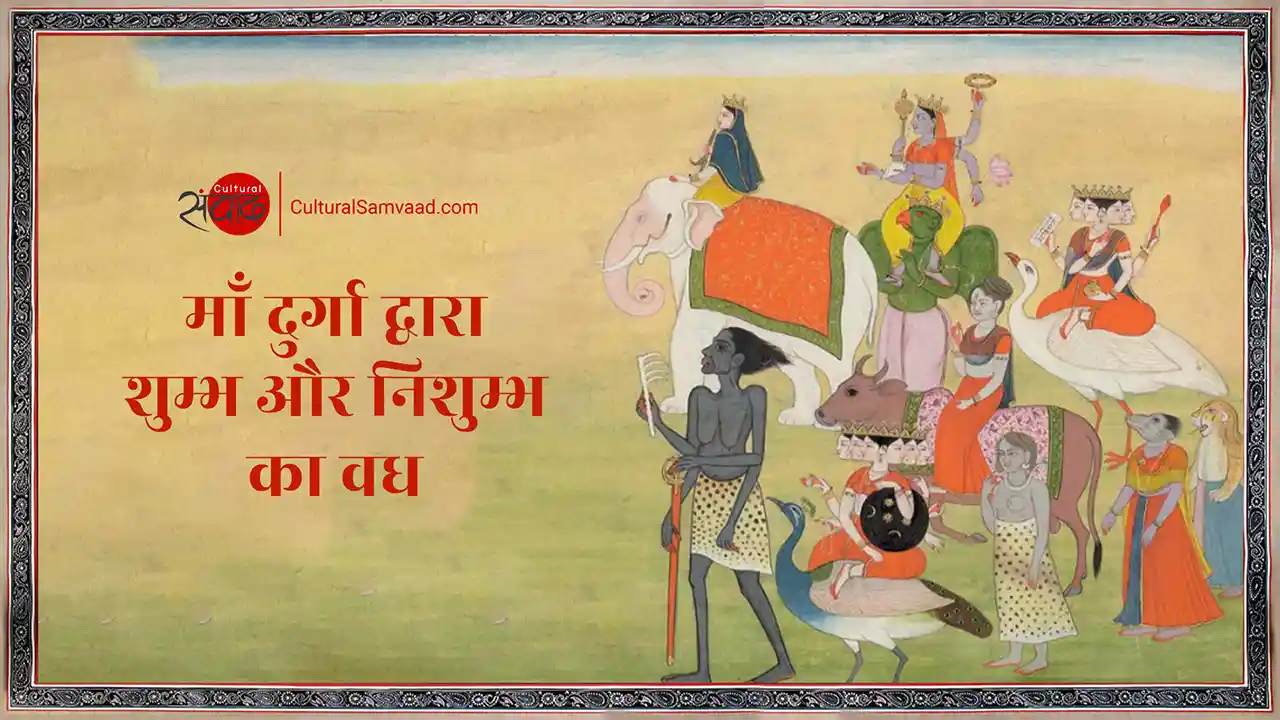
The Saptashati then progresses to the third episode or uttam charitra which is narrated in Chapters 5-11. It recounts the ascent to power of the formidable demon brothers Shumbha and Nishumbha. They displaced Indra and the other devatas from their heavenly positions and usurped their power. The Devi had promised the devatas in an earlier manifestation that she would reappear whenever they needed her and would save them. Remembering her boon, the devatas went to the Himalayas to appease Devi Parvati and sang an exquisite hymn in her praise. Pleased by the devata’s entreatie, Devi Ambika incarnated from the body of Devi Parvati in order to save the devas. Goddess Ambika’s unparalleled beauty attracted the attention of Shumbha and Nishumbha, who wanted to subjugate her. They demanded that she should marry any one of the brothers. The Devi explained to their messenger that as per a vow she had taken, she would only marry someone who was capable of defeating her on the battlefield. Spurned by the ‘arrogant’ Devi, the demons and their army engaged in a battle with her. After their vast armies and their ferocious generals including Dhumralochana, Chanda and Munda and Raktabeeja were trounced, Shumbha and Nishumbha attacked the Goddess. The Goddess slew both of them and vanquished the asura army, thereby, re-establishing the reign of Dharma. The devatas were ecstatic and returned to fulfill their designated roles.
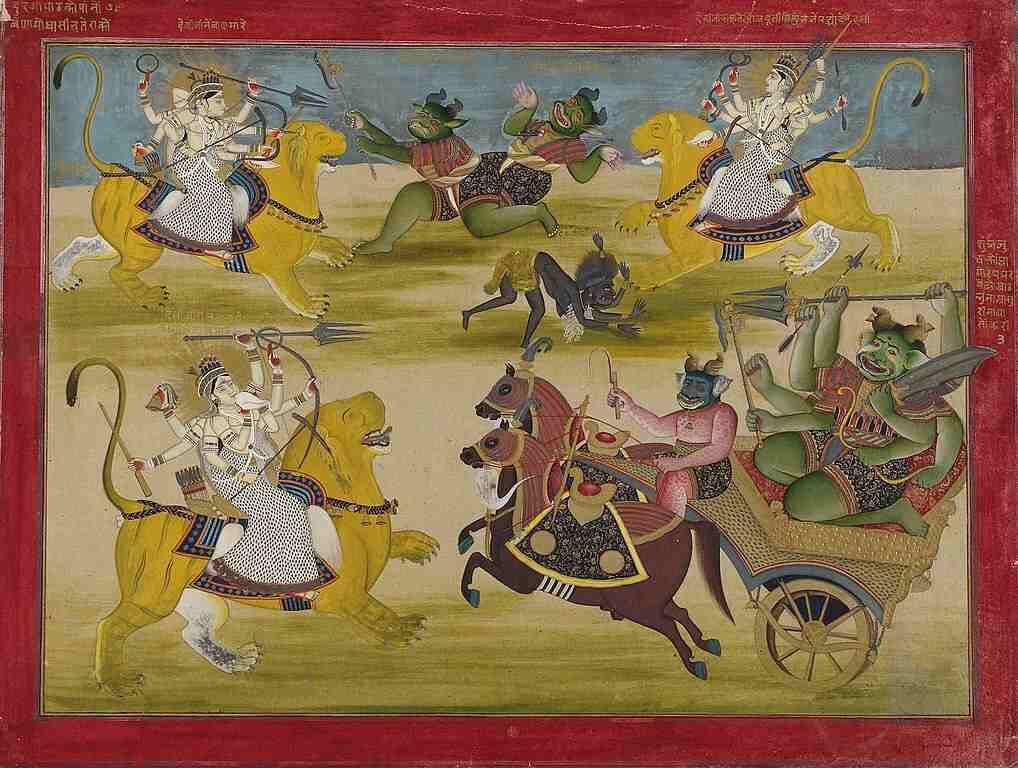
Within this episode, the Saptashati also weaves in the emergence of the Sapta Matrikas (mother goddesses) – Brahmani, Maheshwari, Kaumari, Vaishnavi, Varahi, Narasimhi and Aindri. The matrikas are considered to be the shaktis (energies) of the various gods and devatas. It is pertinent to note that they are not consort goddesses. The narrative also mentions the emergence of the fierce Devi Kali (black) who appeared from the forehead of Ambika which had turned black with anger. Kali is also referred to as Chamunda since she destroyed the ferocious demons Chanda and Munda. Kalika Devi also annihilated the terrible demon Raktabija in this episode.
Read and watch the detailed story of the Third Charitra and understand its significance
The Eternal Promise of Durga Saptashati and Phalashruti
As is customary in texts of this nature, Chapter 12 is dedicated to the ‘phalashruti’ or Mahatmya i.e. fruits of listening and reciting the Saptashati for all devotees. The phalashruti is but a promise that the benevolent mother will protect one and all. Chapters 12 and 13 also help in logically concluding the frame narrative. Suratha and Samadhi propitiate the Devi with severe penance and beseech her for boons of their choice – Suratha in the material world (artha) and Samadhi in the eternal world (moksha).
The Devi Mahatmya is a seminal text about the indomitable, the valiant, the all-powerful and the all-pervading Durga that is relevant in all times and ages. The summary above is intended to serve only as an outline to its stories which are discussed separately and can be accessed using the links above. Though originally composed in Sanskrit, the much-loved Durga Saptashati has been translated into most Indian languages, English and a host of foreign languages. A list of references is appended for further exploration.
देवि प्रपन्नार्तिहरे प्रसीद प्रसीद मातर्जगतोऽखिलस्य।
प्रसीद विश्वेश्वरि पाहि विश्वं त्वमीश्वरी देवि चराचरस्य॥
O Devi, you remove the sufferings of those who approach you and seek refuge in you. Please be gracious to us. O Mother of the Universe, please be benevolent. O Presiding Deity of this World, please protect one and all. O Devi, you are the ruler of all that is moving and not moving in this cosmos.
Durga Saptashati 11.3
Durga Saptashati at a Glance
Notes:
- In English, Mahishasuramardini, Mahishasura mardini and Mahishasurmardini are used interchangeably. The form closest to Sanskrit without diacritical marks is Mahishasuramardini (महिषासुरमर्दिनी).
- Raktabeeja, Raktabij and Raktabija are used interchangeably in English.
- Some people refer to the text as Devi Saptashati but that is not attested to in literature.
[i] The Markandeya Purana is dated by scholars variously. It is definitely not later than the 3rd century CE. The Saptashati (700 verses) is believed to be a later interpolation in the Markandeya Purana but was added at least before the 7th century CE. Please see: Upinder Singh. A history of ancient and early medieval India: from the Stone Age to the 12th century. New Delhi: Pearson Longman. 2008.
[ii] The tradition of Goddess Worship in in the Indus-Sarasvati Civilisation has been proven conclusively based on archaeological evidence. References to various forms of the Goddess are present in the Vedic Literature, Epics and other ancient Indian traditions.
[iii] The Saptashati frame is independent of the Markandeya Purana frame.
[iv] The word ‘Maya’ has many connotations. It generally implies that which is unreal or illusory. The world is supposed to be Maya (unreal) in Vedanta and it is common parlance to say in Hindi – ‘sab moh maya hai’.
Select References:
- दुर्गा सप्तशती. गीता प्रेस.
- Allchin, Bridget (1997). Origins of a Civilization: The Prehistory and Early Archaeology of South Asia. New York: Viking.
- Danino, Michael (2010). The Lost River: On the Trail of the Sarasvati. New Delhi: Penguin India.
- Doniger, Wendy (2010), The Hindus: An Alternative History. New Delhi: Oxford University Press
- Lal, B. B. (2015). The RigVedic People. New Delhi: Aryan Books International.
- Lal, B. B. (2002). The Sarasvati flows on. New Delhi: Aryan Books International.
- Parpola, A. (2015). The roots of Hinduism: The early Aryans and the Indus civilization. New York: Oxford University Press.
- Possehl, Gregory L. (2002), The Indus Civilization: A Contemporary Perspective. New Delhi: Vistaar Publications.
- Singh, Upinder (2008). A History of Ancient and Early Medieval India: from the Stone Age to the 12th century. New Delhi: Pearson Education.
- Thapar, Romila (2004). Early India: From the Origins to AD 1300. University of California Press.

Add comment