


At the tender age of 9, he cremated his father’s sheesh (head) at Anandpur. All his four sons (chaar sahibzaade) were martyred at very young ages. The two elder sons became shaheeds on the battlefield and the younger ones, aged nine and seven were captured and persecuted. And yet, Guru Gobind Singh relentlessly continued his crusade for his mission and his faith in the akal purukh (timeless person) did not waver.
Join Cultural Samvaad’s WhatsApp Community
Guru Gobind Singh’s seminal contribution to the establishment of the Sikh order
Guru Gobind Singhji was the tenth Guru of the Sikh order. Before leaving the mortal world, he proclaimed that the Adi Granth would henceforth be the Guru for all Sikhs – ‘Guru manayo Granth’. His teachings were essentially a continuation of Guru Nanak and the other Gurus. He created the Khalsa or the pure. He said that a pure member of the Khalsa is one who ‘…keeps alight the unquenchable torch of truth and never swerves from the thought of one God; he who is full of Love for God and has confidence in him…’ . (quoted by Khushwant Singh).
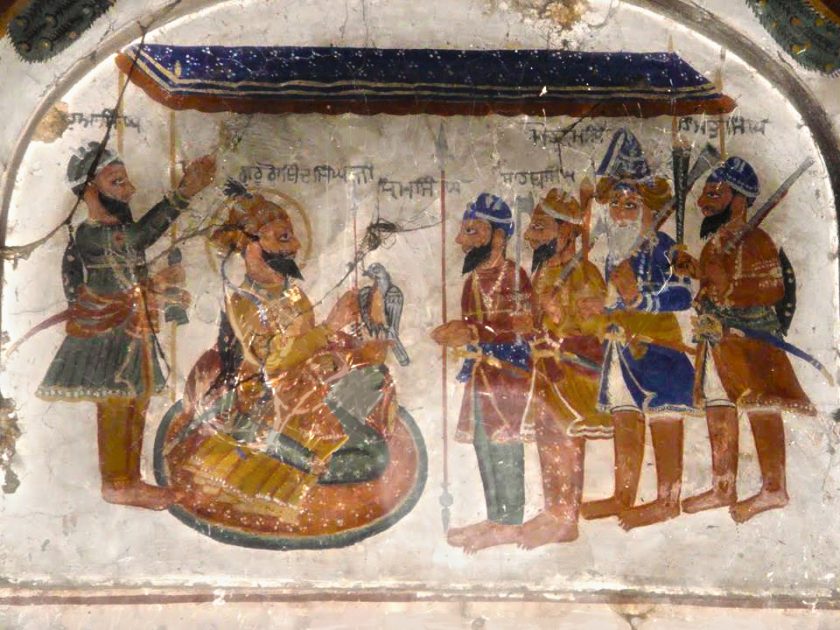
(Creative Commons)
His essential motto was ‘manas ki jaat sab ek hi pahnchanbo’ – all of humankind has one caste. The ‘panj piyares’ (five beloved ones) who were initiated by Guru Gobind Singh into the Khalsa and drank amrit (nectar) from the same bowl belonged to different castes – one was a Brahmin, another was a Kshatriya and the other three belonged to the then so-called lower castes. This was a message of social equality – a highly symbolic ritual in which all castes became one again.
Guru Gobind Singh’s clarion call for Martyrdom
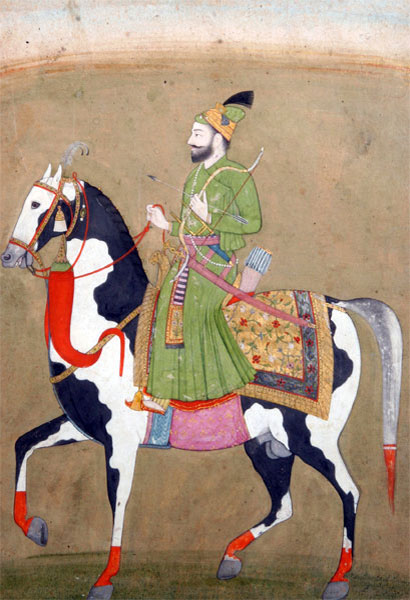
The Guru born in Patna symbolizes buoyant hope (charhdi kala) and an indefatigable spirit to wage a war for Dharama (righteousness). He was a spiritual leader and a prolific poet who gave a clarion call to embrace battle when the times demanded ‘shaheedi’ (the word has not been used by the Guru himself). That is the timelessness of his leadership – that is true ‘prakash’ (light).
In his own words penned with reference to his father’s execution in Bichitra Natak, he said:
“Dharam het saka jin kiya,
Sirr diya par sirarr na diya.”
‘He was martyred for upholding Truth and Righteousness. He gave his head, but not his determination.’ (loosely paraphrased).
Guru Gobind Singh’s contributions to the spiritual and theological lives of Sikhs in specific and Indians in general cannot be eulogised enough. At an intensely personal level, Guru Gobind Singh’s relevance stems from his valour and from the legitimacy he vested once again to war, to bravery and to giving up one’s life to uphold one’s Dharma (it is important to distinguish Dharma from religion). Love for all of humankind and destruction of oppressors can co-exist and do co-exist. Pacifism is not to be confused with cowardice; militancy spurred by malice or greed is not war for Dharma and raising of arms in the battlefield for the establishment of the fundamental principles of the Divine and humankind is not militancy. In our times, like in all of times when human beings have existed, raising of arms is both real and symbolic and wars are not waged for power and territory alone – they are also waged for change. India has always been a pacifist nation ready for war, we are capable of expounding the deepest of spiritual truths and also fighting the toughest of battles. That is the message which the life and teachings of Guru Gobind Singh reiterate.
References:
- Singh, Khushwant (2016). A History of the Sikhs – Volume I. Oxford University Press.
- Singh, Khazan (1914). History and Philosophy of the Sikh Religion – Volume I. Naval Kishore Press.
- Fenech Louis (2013). The Sikh Zafar-namah of Guru Gobind Singh: A Discursive Blade in the Heart of the Mughal Empire. Oxford University Press.

Add comment