


Join Cultural Samvaad’s WhatsApp Community
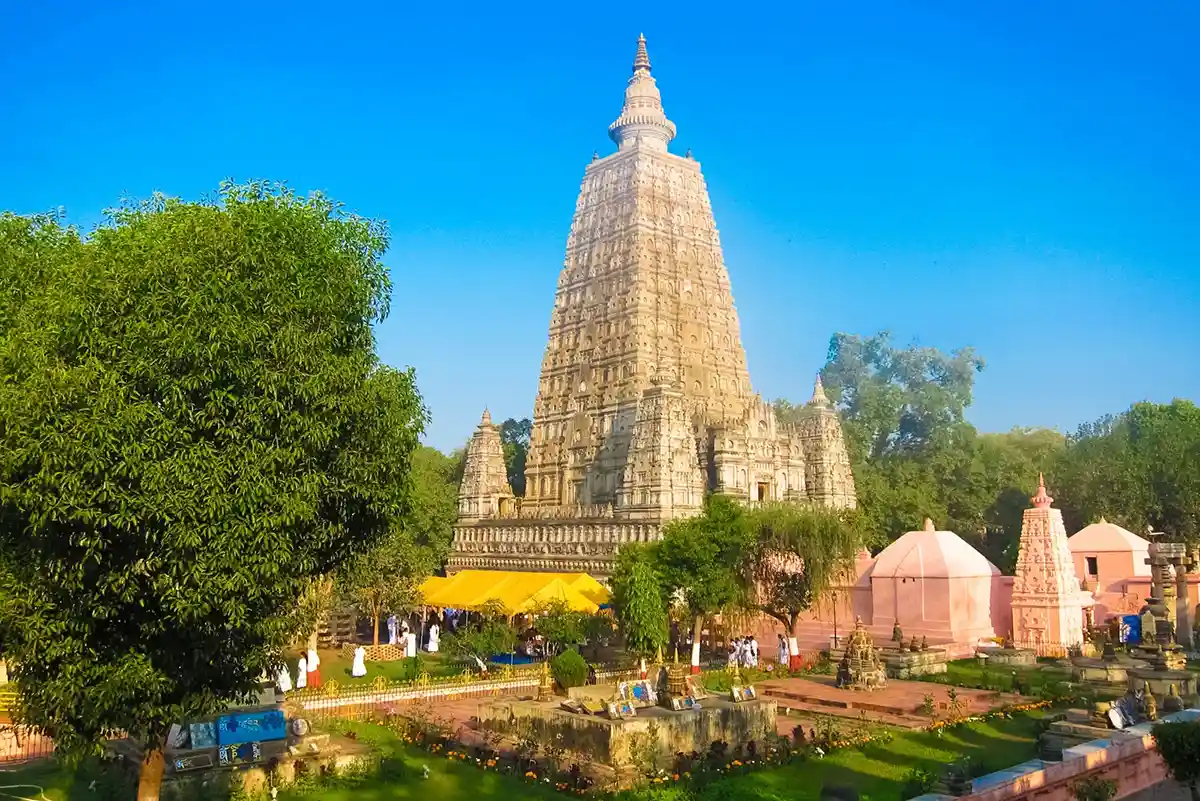
The Mahabodhi Temple Complex at Bodhgaya in the Gaya District of Bihar in eastern India is one of the four holiest sites pertaining to the life of Bhagvato Gautam Buddha. As per the Mahaparinibbana Sutta, the Buddha himself mentioned it as one of the four most important places of pilgrimage for devotees. Even though it was inscribed in the UNESCO World Heritage List only in 2002, it has been revered for over 2,500 years and was referred to as Uruvela or Buddha Gaya at different points in time.
Mahabodhi Temple – The Genesis
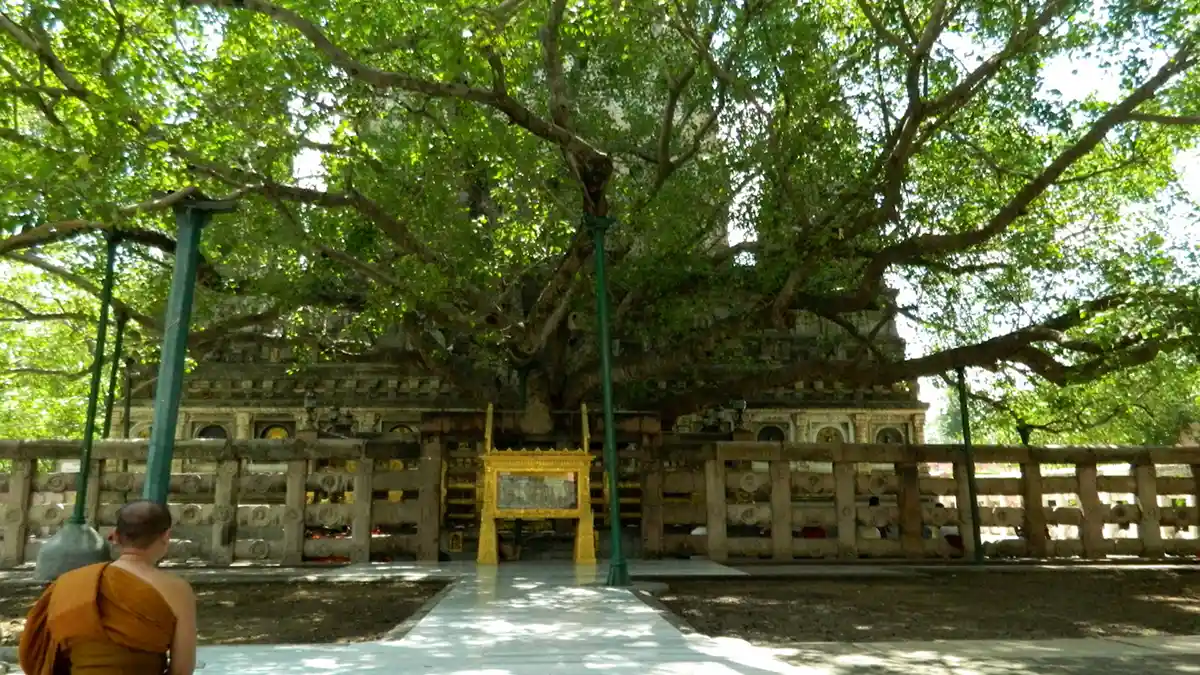
As per tradition, the virtuous Sakyamuni sat on the bodhimanda or seat of enlightenment under a sacred pipal tree (ficus religiosa) in the precincts of this complex. Under this very pipal tree, he comprehensively defeated the life forces of Mara and called upon the earth to be his witness for this unprecedented act. He then became the Buddha – the Awakened One or the Enlightened One during the full moon night of the month of Vaisakha in the 5th century BCE.
Know More: Life of the Buddha
At the time of the Buddha’s awakening, Uruvela was then a part of the kingdom of Magadha (mahajanapada). The Phalgu or Niranjana River along which this town is situated is also of immense importance to the Hindus who come to Gaya (and also to Bodhgaya) to perform the shraddha ceremony for their ancestors.
Mahabodhi Temple – The Story
Our story of the phased development of the Mahabodhi Mahavihara begins with this very divine pipal tree.
The Early Days: An Open-Air Shrine
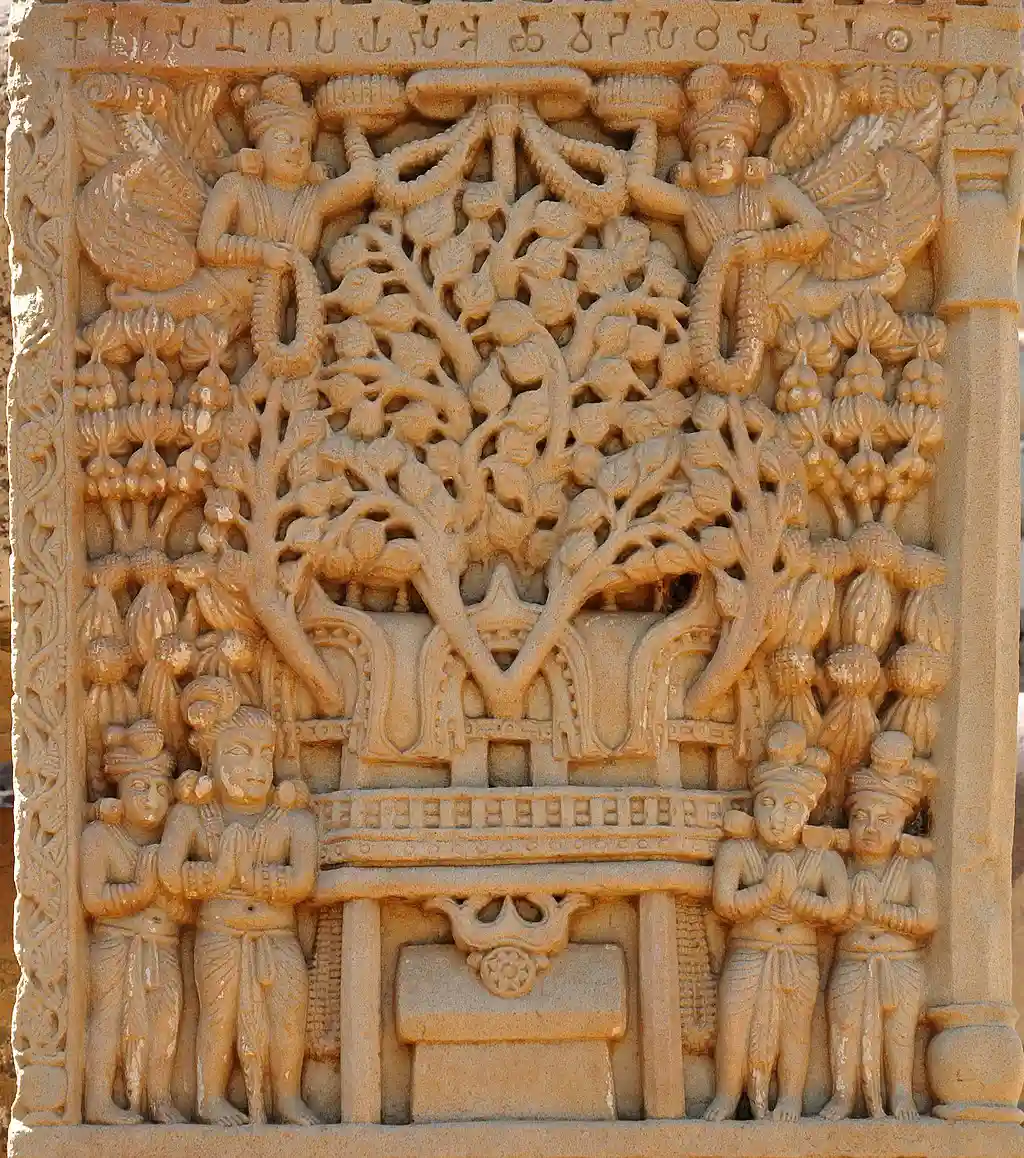
As per tradition, the worship of the holy Bodhi Tree under which the Buddha attained Samyak Sambodhi probably began during the Buddha’s lifetime. The earliest known images of the shrine from the Bharhut Stupa and the Sanchi Stupa indicate the existence of an open-air Bodhighara (tree shrine) enclosing both the tree and the vajrasana or the Diamond Throne to symbolically mark the spot where Sakyamuni sat. They probably represent the temple in its renovated avatar as was commissioned by Emperor Ashoka in the 3rd century BCE.
The stone railing which provided a circumambulatory path was either enlarged, replaced or added in the 2nd – 1st centuries BCE during the Sunga period through the patronage of Kurangi and other noble women donors.
The Mahabodhi Temple Rises
A terracotta plaque from Kumrahar (now in the Patna Museum) which is dated to the Kushana period seems to suggest a towered temple, but this has not been adequately established.
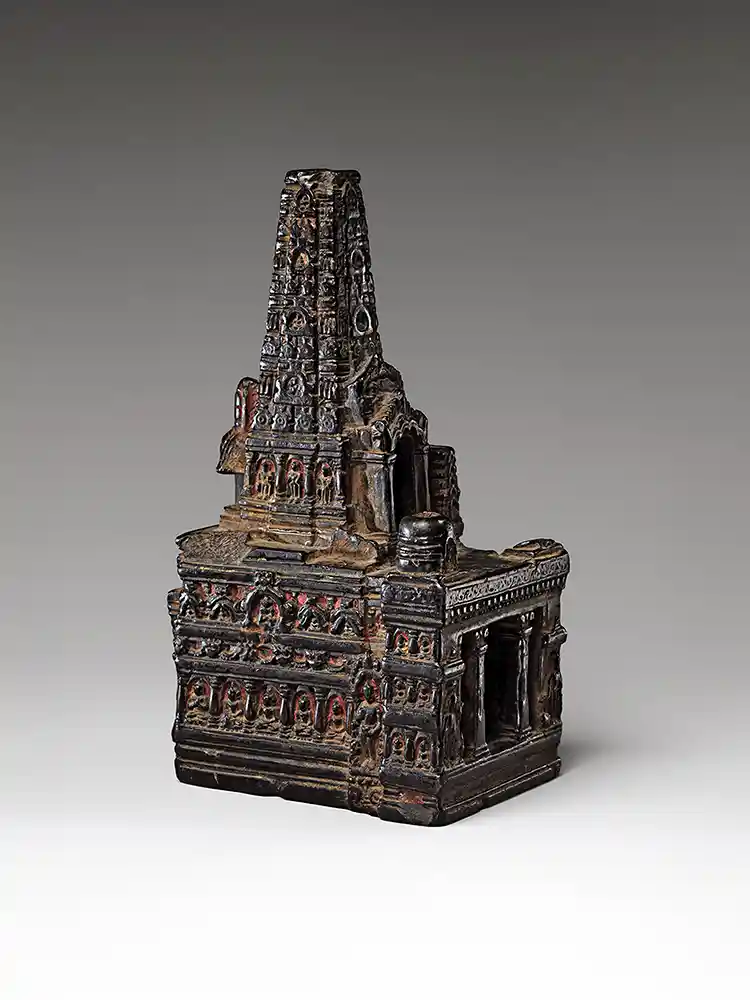
The transformation from an open-air shrine to a towered brick temple (probably referred to as a vajrasana–gandhakuti or perfumed temple enshrining the Diamond throne) happened during the Gupta period somewhere between the 4th and 6th centuries CE though the exact date is not agreed upon. “By the 6th century, that was almost certainly a large temple at Bodh Gaya. At that time, a community of Sinhalese monk seems to have settled there and asserted considerable authority over the site.” (Asher, 2008) It has also been suggested (though inconclusively), that the temple which was undeniably Indian in conception and execution may have been built or supported by the Sri Lankans sometime during the fifth-sixth centuries CE.
The Grandeur of the Mahabodhi Temple: Xuanzang’s Testimony
The Chinese pilgrim Xuanzang who visited Bodhgaya in the 7th century CE testified to the existence of a grand multi-storeyed shrine, stunning images of the Buddha and the patronage of the Brahmanical Hindus including probably Amara Sinha, the author of Amara Kosha. While Xuanzang’s account of the temple, the Buddha image or the legend of its construction cannot be taken in a literal sense, they do provide important clues and directions for research.
To the east of the bodhi tree is a shrine one hundred sixty or seventy feet high, built on a base of which the front is more than twenty paces wide. It was built with brick and plastered with lime. In all the niches arranged in tiers, there are golden images, and on the four walls there are marvellous carvings in the shapes of strings of pearls or figures of spirits. On top is installed a gilded copper amalaka fruit (also said to be a precious bottle or a precious pot). It is connected with a storied pavilion at the east, the eaves of which are in three layers. The rafters, pillars, ridgepoles, beams, doors, and windows are adorned with gold and silver carvings and studded with a mixture of pearls and jade. The innermost chamber of the shrine has three doors connecting with the other parts of the structure. On each side of the outer door there is a niche containing an image of Avalokiteshvara Bodhisattva on the left side and one of Maitreya Bodhisattva on the right side, both cast in silver and more than ten feet in height.
Xuanzang (629–644 CE) – Da Tang Xiyu Ji (The Great Tang Records of the Western Regions) (Li, 1996).
There was once a brahman who did not believe in the buddha-dharma but worshiped the deity Mahesvara. He heard that the deity was living in the Snow Mountains, so he went with his younger brother to seek the fulfillment of his wishes from the deity. The deity said, “Your wishes can be fulfilled only when you have done meritorious deeds. It is not that you can get things by merely saying prayers, nor can I make you satisfied.” The brahman said, “What meritorious deed should I do so that my mind can be satisfied?” The deity said, “If you wish to plant the seed of goodness you should find the field of blessedness. The bodhi tree is the place where the Buddha attained buddhahood, so you should quickly go back to the bodhi tree and build a great shrine, dig out a large pond, and make various offerings. Then your wishes will be fulfilled.” Under the deity’s injunction the brahman, cherishing a mind of great faith, returned with his younger brother. The elder one built the shrine, and the younger one excavated the pond. Then they made rich offerings to seek the fulfilment of their wishes. They finally realized their wishes and became cabinet ministers to the king. They gave away as alms whatever emoluments or rewards they received.
Xuanzang (629–644 CE) – Da Tang Xiyu Ji (The Great Tang Records of the Western Regions) (Li, 1996).
It is pertinent to note that a stone inscription excavated at the site seems to suggest that Amara Deva constructed the temple as per the instructions of Mahadeva in a vision. However, Rajendralal Mitra had questioned the authenticity of the inscription. “Even if the stone inscription of Bodh Gaya were fake, Xuanzang’s testimony by itself hints at the indelible contribution of the Brahmanical Hindus in the growth and development of the Mahabodhi Temple.” (Sarao, 2020)
The Mahabodhi Temple and its adjoining structures were continuously renovated, restored and embellished over the next few centuries. The monument reached its zenith in the 9th to11th centuries CE, “under Pala and Sena rule, when it clearly stood as a thriving hub of royal patronage, artistic production, and pan-Asian Buddhist activity.” (Guha-Thakurta, 2004).
Take a Quiz on the Life of the Buddha
The Decline of the Mahabodhi Temple
Unfortunately, the holy site seems to have been all but abandoned after Turuska attacks began in the region towards the end of the 12th century CE. The Tibetan monk, Dharamswamin’s records are important in this regard.
The place was deserted and only four monks were found staying (in the Vihara). One (of them) said, “It is not good! All have fled from fear of the Turushka soldiery”. They blocked up the door in front of the Mahabodhi image with bricks and plastered it.…The monks said, “We five do not dare to remain here and shall have to flee.” At daybreak they fled towards the North following the rut of a cart, and for seventeen days the Dharmasvamin did not see the face of the image (i.e., the Mahabodhi image). At that time also a woman appeared, who brought the welcome news that the Turushka soldiery had gone far away. Then the Dharmasvamin returned to Vajrasana and stayed there worshipping and circumambulating the image of the Mahabodhi.
Testimony of Dharmasvamin, a Tibetan monk who travelled to India between 1234 and 1236 CE. (Reconstructed from Roerich,1959 by Sarao, 2020.)
However, the decline of this holy place cannot be attributed only to these attacks, and other factors must have contributed to it. There are some epigraphical records suggesting repairs in the 12th and 13th centuries CE by the Burmese and also by a few Tibetan and Sri Lankan monks. “The Mahabodhi Temple fell prey to the vagaries of nature for nearly four centuries.” (Sarao, 2020)
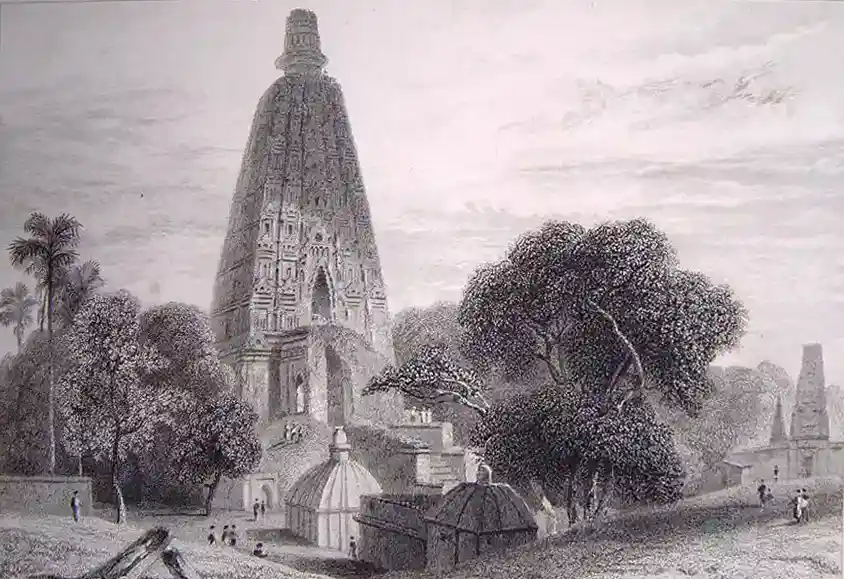
As per traditional records, a wandering Saiva Sanyasi, Gossain Ghamandi Gir is said to have come to the deserted sacred spot in 1590 CE. Moved by its overwhelming holiness and serenity, he took up residence there and established a math. Over the next few centuries, the then derelict temple and its surroundings came under the Saiva mahants who continued to preside over the temple till the 19th century CE. The precincts saw additions, but it seems that there was no large-scale vandalism (as has been suggested by some later Victorian Indologists) and both Buddhists and Hindus continued to pray and worship at the site.
Appropriation of a derelict temple by a sannyasin such as this one, located near a small village, was an act that no one questioned. The practice of derelict Indic sites with a sacred background being reused by other Indic faiths was not uncommon at all during the ancient and medieval period. Multiple affiliation was quite normal rather than exceptional among the various Indic faiths. (Sarao, 2020)
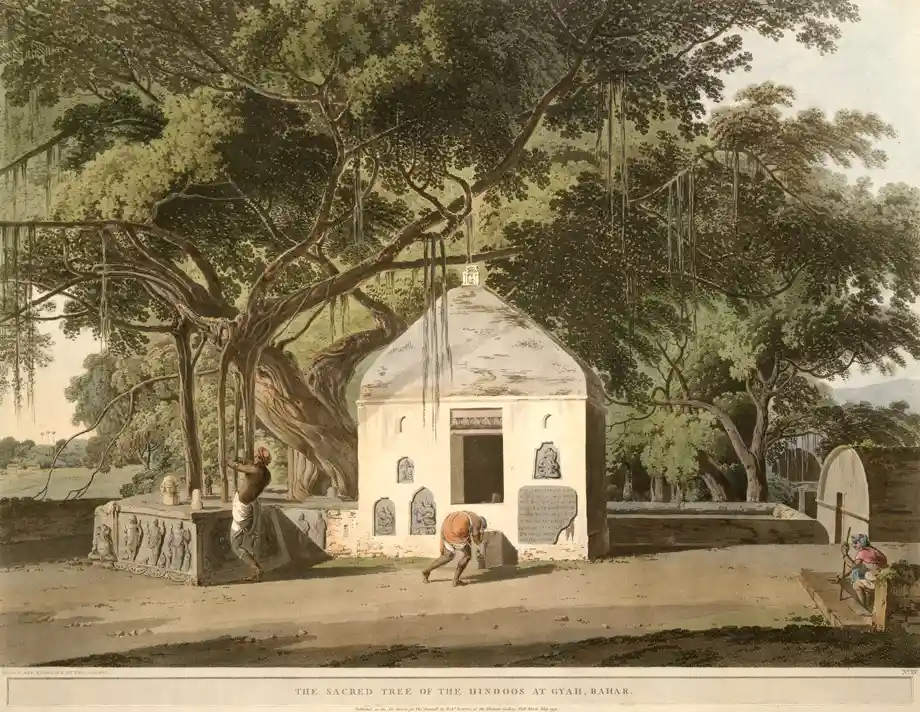
The ‘Disruptive’ Rediscovery and Renovation of the Mahabodhi Temple
The 19th century CE was a momentous year for Bodh Gaya. In addition to the occasional pilgrims, Buddha Gaya also started receiving European visitors and there was a revival of interest in the site. “The Europeans visiting the site invariably described it in terms of ruin, indirectly and perhaps unintentionally a charge against the mahant’s role in maintaining the site but also a trope consistent with our district admiration for ruin.” (Asher, 2008)
In 1876, the then Burmese King Mindon Min commenced repairs at the Mahabodhi Temple which were criticised by the likes of Rajendralal Mitra on archaeological and aesthetic grounds. Eventually, the site was excavated, and the Mahabodhi temple was rebuilt in 1883 under the stewardship of Alexander Cunningham, the Director of Archaeological Survey of India, along with J.D. Beglar and Rajendralal Mitra (both of whom seemed to have been replaced during the reconstruction).
Unfortunately, the nineteenth-century changes made at Bodhgaya have greatly confused the record of earlier activity. Some structures were totally dismantled, and many images were moved from their original locations. Sadly, only limited excavations were made before the well-meaning but disruptive renovations. (Leshoko, 1988)
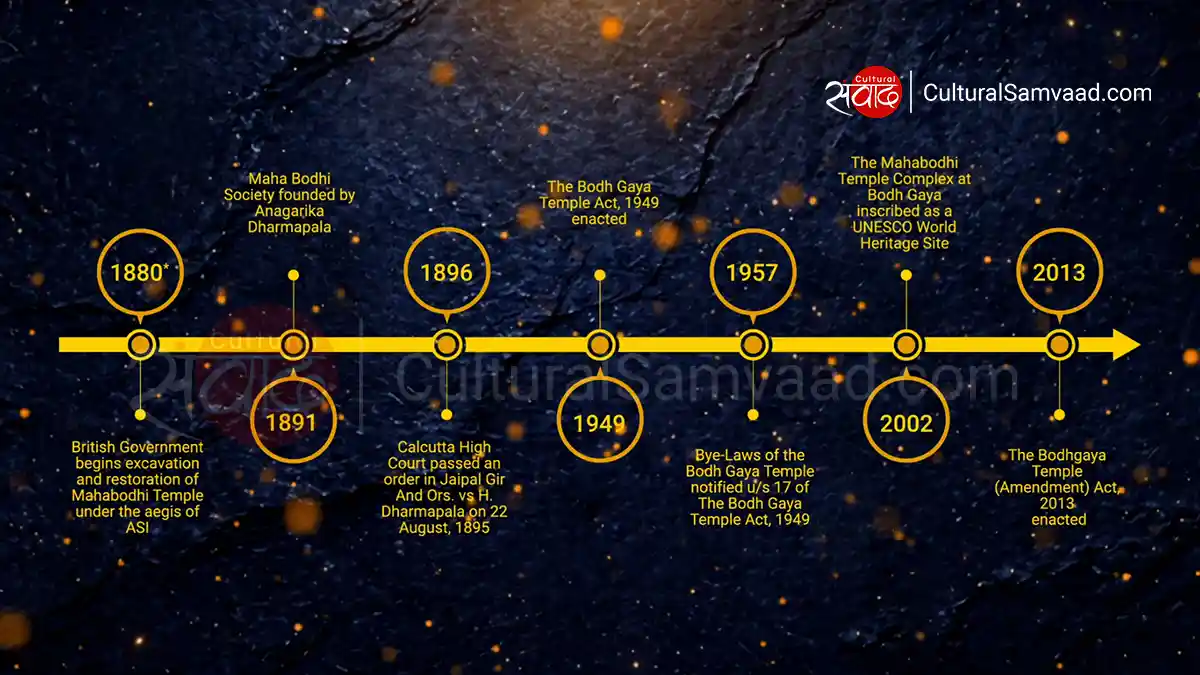
The excavation and reconstruction notwithstanding, there was another storm brewing at and for Bodh Gaya. In 1891, Anagarika Dharmapala, a Sri Lankan monk founded the Maha Bodhi Society and began a campaign to restore the Mahabodhi Temple and its precincts to its so-called “legitimate” owners. He supported by the anti-Hindu propaganda of Victorian Indologists such as Edwin Arnold.
The idea of restoring the Buddhist Jerusalem into Buddhist hands originated with Sir Edwin Arnold after having visited the sacred spot in 1886. It was he who gave me the impulse to visit the shrine, and since 1891, I have done all I could to make the Buddhists of all lands interested in the scheme of restoration.
Anagarika Dharmapala – Extract from his Diary reprinted in Guruge, 1965.
But Buddha-Gya is occupied by a college of Saivite priests, who worship Mahadeva there, and deface the shrine with emblems and rituals foreign to its nature. Apart from the immense historical, religious and social importance of Buddhism in Asia, here is an opportunity for the Government of India to gratify and conciliate half that continent by the easiest and least costly exercise of good-will.
Edwin Arnold – Buddha-Gya | Daily Telegraph, 1893
Both the renovation of the temple which left a lot to be desired, and the motivated political activism of that era had far-reaching ramifications including protracted legal cases and the enactment of multiple laws relating to the temple’s administration and management through the 20th century CE, a detailed discussion of which is beyond this piece.
Sufficeth to say that vestiges of the past continue to occasionally cloud the present too. Let us leave this story and shift our focus to the hallowed precincts of the Mahabodhi temple complex which is an embodiment of the awakened one.
Mahabodhi Temple Complex – Embodying Sambodhi
Today, the Mahabodhi Mahavihara is home to the 55-m high, east-facing, towering main brick Temple, the Vajrasana, the sacred Bodhi Tree, the Buddhapada (imprints of the feet of the Buddha), the legendary stone railing and also to sacred sites where the Buddha is believed to have spent seven weeks after enlightenment as per certain traditions.
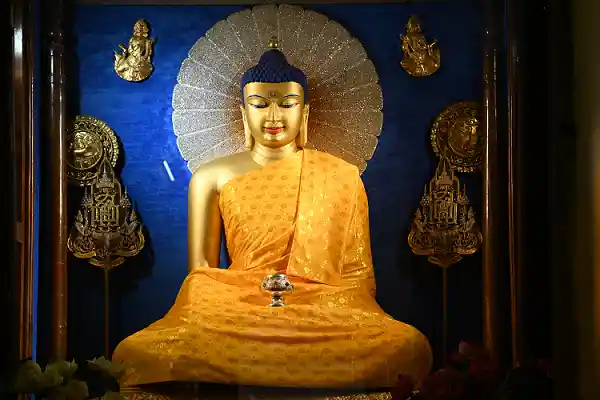
The main temple is rectangular in plan with a towering shikara topped by an aamalaka and kalasha. A 10th-century, five-feet high, image of the great Gautam Buddha in bhumisparsha mudra symbolising his momentous Enlightenment, sanctifies the sanctum sanctorum and uplifts the devotee. This image which is made of black stone has now been covered in gold and is not the same as was seen by Xuanzang. Even the temple’s upper finial was gilded in 2013 with ~ 289 kgs of gold which was largely donated by the King and other lay devotees from Thailand.
The precincts and the outer walls of the temple are dotted with moving images of the Buddha and many Bodhisattvas. The holiness of the direct descendant of the original sacred Bodhi Vriksha which we will revisit later in this piece and the enlarged bodhimanda towards the west can only be experienced and not stated. A majority of the pillars of the railing that also mark one of the main circumambulatory paths or pradakshina path at the temple today are replicas of the exquisitely ornamented original ones which are either at the ASI Museum or have been lost.
One of the most striking features of the site which binds the pilgrims of today to those from the past, is the presence of innumerable votive stupas sometimes with funerary connections. While most of them are now not in situ, one can still behold over two hundred large stone, collage stupas in the courtyard. The Annapurna Temple and an uninscribed pillar shaft in the compound which is inconclusively attributed to Ashoka also deserve special mention.
Before we move away from the Mahavihara, we should spend a few moments in understanding and appreciating the seven sub-sites which were home to Gautam Buddha after his awakening as per some schools of Buddhist thought. These sub-sites were inscribed as per a scheme that was decided upon as recently as 1989 and attract both the devotee and the tourist. Accounts state that:
- Buddha spent the first week under the sacred Bodhi Tree (Bodhi Pallanka).
- He spent the second week gazing unblinkingly at the Bodhi Vriksha from a platform under a tree outside the Animesh Lochan Chaitya, i.e. the temple which is popularly known as the Tara Temple and is stylistically similar to the main shrine.
- The Tathagata spent the third week walking back and forth in meditation on a jewelled pathway which is now referred to as the Chankramana and is adorned with lotuses that are said to have sprung up from the Buddha’s feet.
- He spent the fourth week in meditation at the Ratnaghara Chaitya.
- The Buddha spent the fifth week at the bottom of the Ajapala Nigrodha tree (banyan tree).
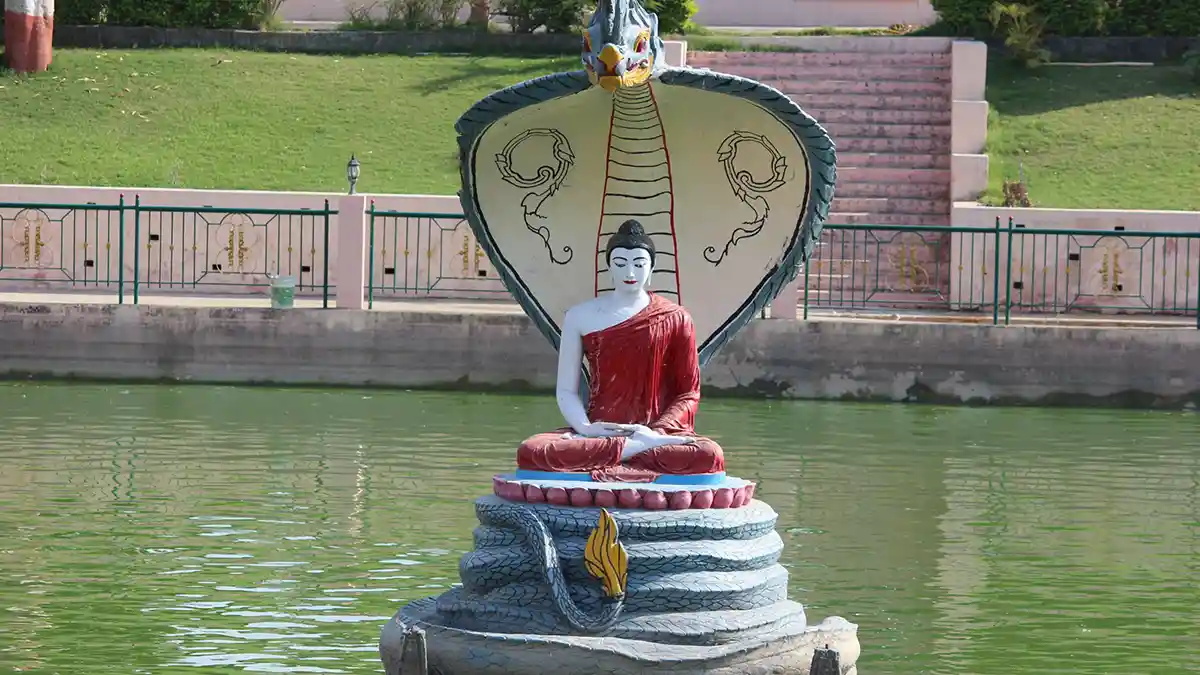
- During the sixth week, Sakyamuni meditated in front of the Lotus pond where the Muchilinda Lake stands today and where the Naga King Muchalinda is said to have protected the Tathagata from pouring rains.
- He spent the seventh and final week under the Rajayatana tree.
The relatively modern Archaeological Museum of Bodhgaya that houses several exquisite artifacts and the ancient Sujata Stupa, which is located in the village of Senanigrama, not far from the main temple complex are integral parts of the landscape of Bodh Gaya.
The Sujata Stupa is said to have been built at the spot where a lady from the village offered the Buddha a meal of rice and milk (kheer or payasam). This meal rejuvenated the Buddha after his inclement fasting and is traditionally believed to be his last meal before he began his final quest for enlightenment.
Mahabodhi Temple and the Bodhi Tree – Global Model for Manifesting the Buddha
As Buddha’s Dhamma and the Sangha travelled beyond the shores of the Indic lands, metaphorically speaking, so did Buddha Gaya.
The Many Travels of the Bodhi Tree
It has been suggested that a symbolic Bodhi Tree was inaugurated by the Buddha himself or by Ananda, one of his favourite disciples at Shravasti. This tree is called the Anand Bodhi tree. As per tradition, a sapling of the sacred Bodhi Tree was carried to Anuradhapara in Sri Lanka by none other than Ashoka’s daughter, Bhikkuni Sanghamitra nearly 2,250 years ago. Since then, this tree referred to the Jaya Sri Maha Bodhi Tree has spawned many a Bodhi tree in Sri Lanka, other Buddhist countries and India. The Bodhi Tree at Deekshabhoomi in Nagpur also traces its antiquity to the Jaya Sri Maha Bodhi Tree and hence to the original Bodhi Tree at Uruvela.
The Many Travels of the Mahabodhi Temple
The Mahabodhi Temple itself travelled across the world not only as replicas and representations but also as a model for constructing temples by kings to honour the Buddha, amass religious merit and political power and create local, metaphorical places of pilgrimage for the devout. Some of the temples that derived inspiration from the Mahabodhi Temple include:
- The Mahabodhi Temple at Bagan in Myanmar
- The Five Pagoda Temple in China
- The Wat Chet Yot at Chaing Mai in Thailand
- The Wat Maha That Wachiramongko in Thailand
- The Mahabuddha Temple at Patan in Nepal
- The Thatta Thattaha Maha Bawdi Pagoda at Myanmar
Bodh Gaya – Manifesting Asia
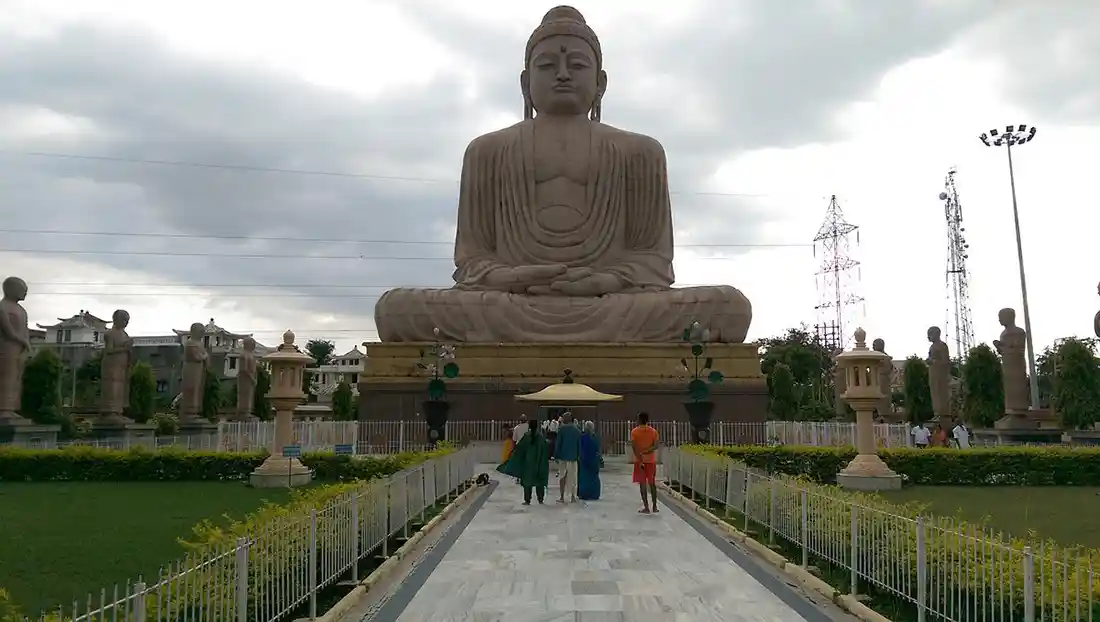
Let us now return to the original Bodhgaya in India that is Bharat, the holy site where Sakyamuni once roamed and which has been a coveted destination for nuns and monks, for Buddhist and Hindu pilgrims, for travellers and unfortunately, for invaders from beyond the Indic lands. The multi-layered and multi-valent palimpsest of this holy site continues to be engraved on by the devout from all corners of Asia who pray and meditate in its sublime and spiritual surroundings, construct chaityas and viharas that manifest the Buddha and his Dhamma, embody the Buddha and Bodhisattvas in monumental images and mould the landscape in innumerable but characteristically Asian ways. The Great Buddha Statue which was contributed by the Daijokyo Buddhist school from Japan and consecrated by the 14th Dalai Lama in 1989 and the large 30-metre reclining Buddha contributed by the Buddha International Welfare Mission in 2023 are notable additions to the landscape of Bodhgaya in recent years.
Bodhgaya is the navel of the spiritual legacy of the Buddha and of a pluralist Bharat. It is incumbent upon the nation to shape this sacred site in a manner that not only preserves, conserves and furthers the shasana of Buddha but also embodies and mirrors the quintessential nature of India as the home of the Buddha and her soft power.
Editor’s Note: This long form note and its accompanying video are based on extensive research by erudite scholars (especially Asher and Sarao) whose work has been cited extensively. In addition, the author has referred to the websites of museums and government institutions and images and videos in the public domain. The author does not claim that this note presents a comprehensive story of Bodh Gaya and the Mahabodhi Temple. It merely intends to help the reader in appreciating this divine site that manifests the Buddha and its multi-layered past and in framing some of the challenges that lie ahead. We welcome comments and suggestions.
Select References:
- Arnold, Edwin. 1896. East and west, being papers reprinted from the “Daily Telegraph” and other sources. London: Longmans, Green and Co.
- Asher, Frederick M. 2008. Bodh Gaya monumental legacy. New Delhi: Oxford University Press.
- Barua, D.K. 1981. Buddha Gaya temple: Its history. Buddha Gaya: Buddha Gaya Temple Management Committee.
- Cunningham, Alexander. 1892. Mahabodhi or the great Buddhist temple under the bodhi tree at Buddha-Gaya. London: W.H. Allen & Co.
- Guha-Thakurta, Tapati. 2004. Monuments, objects, histories: Institutions of art in colonial and postcolonial India. New York: Columbia University Press.
- Guruge, Ananda. 1984. From the living fountains of Buddhism. Colombo: Ministry of Cultural Affairs.
- Kinnard, Jacob N. 1998. When is the Buddha not the Buddha? The Hindu/Buddhist battle over Bodhgaya and its Buddha image. Journal of the American Academy of Religion 66 (4): 817–839.
- Leoshko, Janice (ed.). 1988. Bodhgaya: The site of enlightenment. Bombay: Marg.
- Li, Rongxi (trans.). 1996. The great tang dynasty record of the western regions. Berkeley: Numata Center for Buddhist Translation and Research, Berkeley.
- Mitra, Rajendralal. 1878. Buddha Gaya: The great Buddhist temple, the hermitage of Sakya Muni. Calcutta: Bengal Secretariat Press.
- Roerich, George N. (decipherer and trans.). 1959. Biography of Dharmasvamin (Chag lo tsa-ba Chos-rje-dpal): A Tibetan Monk pilgrim, with a historical and critical introduction by A.S. Altekar. Patna: K.P. Jayaswal Research Institute.
- Sarao, K. T. S. 2020. The History of Mahabodhi Temple at Bodh Gaya. Singapore: Springer Nature Singapore Pte Ltd.
- https://whc.unesco.org/en/list/1056/

amazing: loved the way you write